Walthamstow’s “other” surviving mansion

The winter I looked at 62 Walthamstow houses I walked past The Chestnuts often. Even then, not long empty but without a purpose, it looked elegant as only an eighteenth century house can, but shabby and worthy of better things. It’s just a shame that now, nearly ten years later, it looks no better. And, after some 125 years in the ownership of the local authority, it is on the Buildings at Risk register.

Lots of people pass The Chestnuts without realising it is still there. Set back from Hoe Street and half hidden by railings and uncared-for trees, it looks oppressed by the petrol station on one side and the new school, far too close, on the other. At the back, all but a tiny strip of garden has been swallowed up to make a playing field for the school. At one end of the strip an ancient holm oak is the last remnant of what were once lovely grounds. Now the word is that even that is under threat.

There is hope for The Chestnuts. Waltham Forest Council are currently discussing future uses, and undertaking some consultation. Relatively few people, with the exception of the property guardians who currently live there, have recently seen inside the house to see how much of its beauty has survived the chequered years as, successively, mental hospital, school and college. Its earlier life was as home to a succession of City grandees who returned to the peace and salubrious air of Walthamstow at the end of the working day. At least the decades of ad hoc maintenance have meant that not only the original eighteenth century staircase and plasterwork have survived, but there are overlooked treasures such as floorboards, cupboards and fireplaces that have been covered over rather than ripped out.

A few years ago a senior council official told me the people of Waltham Forest have one eighteenth century mansion – the William Morris Gallery – and surely could not expect the local authority to “allow them access” to another. At that time The Chestnuts was evidently regarded as just as much of a burden as the William Morris Gallery had been not long before. Famously, the Gallery is now a much-loved success story (and let’s not be mean and rub in the fact that Morris left Walthamstow at the first opportunity, rarely returned and sneered at it as “cockneyfied”). The point is that his old home is cared for, visited and used for events, exhibitions and performances.

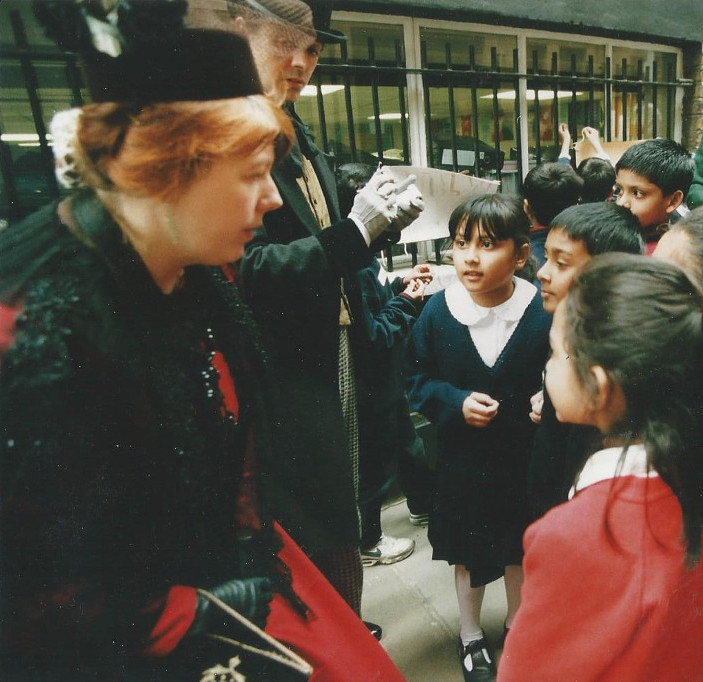
There are some cracks in the ice. There have been a couple of guided tours organised by the Council. And in the past few months, over 120 Walthamstow primary school children have visited, sung, drawn, taken pictures and written poetry inspired by the house. This was as part of Clio’s Company’s Walthamstow Notes project.

The next opportunity to visit is on Saturday 15th June as part of the E17 Art Trail – a free event. There will also be a guided walk, led by Joanna Moncrieff of Westminster Walks, which will set the Chestnuts in its original context as part of a Hoe Street that was lined with grand houses.

And there will be an opportunity to make suggestions as to future uses for this battered but magical place. Not including, I do trust, grand offices or grander flats that would exclude the community that has owned this place for so many years.

Permanent link to this article: http://lissachapman.co.uk/walthamstow/walthamstows-other-surviving-mansion/

Aphra Behn: “The Poetess”

I’ve lost count of the number of times Aphra Behn has been rediscovered. From polite footnotes in academic papers, one or two works included in an anthology, to Maureen Duffy’s tantalising “The Passionate Shepherdess”. Then in the mid 80s, there was Jeremy Irons having far too much fun in “The Rover”, an assortment of university productions, often of “The Lucky Chance”, and Janet Todd’s new editions and biography. Sometimes there have been enthusiastic reviews, occasionally a clutch of productions one after the other, with the odd radio programme and one-woman show. But each time the fuss dies down and, yet again, Aphra Behn is scarcely on the radar even to many actors and to those who feel they could walk the streets of Restoration London blindfold.

And I can’t help being selfishly glad it’s taking so long. Far more people like the idea of liking Behn’s writing than get round to reading any, let alone staging anything other than “The Rover”. So her last play, written in her final months has been virtually forgotten since its one disastrous outing shortly after Behn’s death. “The Widow Ranter”, set in 1670s Virginia, features a storyline loosely based on a real-life colonial uprising, three different love stories, a hard drinking, smoking, cross-dressing heroine, satire, exotic spectacle, music and risqué humour. And by the time it was staged, in the aftermath of the arrival of William and Mary, the world Aphra Behn knew had begun to reshape itself.

Restoration London can’t have been an easy place for anyone to live. Fire, plague and the divisions left by two decades of civil upheaval affected everyone – and the reality of Charles II’s reign was more complicated and less benign than the maypole dancing, golden era whose imagined ghost still clings. But this was also the time when theatre returned to London and, with it, the first professional actresses. There were two licensed theatre companies, vouched for by the King and the Duke of York, both of whom were avid playgoers. And as few productions ran for more than three performances at a time, there was a great demand for new plays. No one knows how Aphra Behn, a possibly widowed, certainly penniless Canterbury barber’s daughter, looking for gainful employment after a disastrous short lived career as a spy, broke into a largely aristocratic and exclusively male circle of playwrights. And once in the circle, there she stayed: her plays pulled in the audiences. And no amount of jealous sniping detracted from that fact.

After the success of her first play, “The Forc’d Marriage”, Behn went on to write eighteen more, and through the 1670s and 80s her name became well known to theatre audiences – she evidently managed to earn her living by her writing, taking on translation work to make ends meet. And, remarkably in a world where most women expected to have a protector if not a husband, Behn remained independent. A passionate Royalist all her life, Aphra Behn was evidently heartbroken at James II’s ignominious departure in 1688 after only three years as king – but by this time her health was breaking down.

All her writing life, Aphra Behn had been pushing, usually gently, at the boundaries of what was acceptable in a storyline. Polemic, the latest London jokes, exoticism and elegant eroticism all made an appearance. And Behn’s women are not all of the witty, bright but virginal kind found in so many other plays of the time. Usually, though, it is only the second lead who is allowed a past. In “The Widow Ranter” it is the eponymous heroine, who has arrived in Virginia as an indentured servant and married her rich elderly employer; her present lifestyle includes drinking, smoking, cross dressing and sword fighting – and it is most certainly she who decides on, and pursues, the man of her ultimate choice. All a step too far in the new climate of 1689? When the play was published, it was with a preface that blamed poor casting and too few rehearsals for the failure of a play that, on examination, seems unfinished. It is impossible to know for sure. But although some of Behn’s work stayed in the repertoire for years, and although she had been allowed the honour of a tomb in the cloister of Westminster Abbey, as times changed she became first embarrassing and then unmentionable. Even Virginia Woolf in her famous tribute to Behn, was suggesting that “all women together” should cast flowers on to her grave, it was as a trail blazer rather than as a creator in her own right that Behn was to be honoured. The time is long overdue to change that.

Clio’s Company are working on several projects related to Aphra Behn. One of them is to restage “The Widow Ranter” for the first time since 1689. A semi staged reading at Fulham Palace was just the start. More news, I hope, soon.

Permanent link to this article: http://lissachapman.co.uk/aphra-behn/aphra-behn-the-poetess/