Lissa is a theatre director, historian and author. In previous lives she has worked in publishing, journalism and for the National Trust, but has now largely returned to her theatrical roots. Lissa is co-founder and, with Jay Venn, Joint Artistic Director of Clio’s Company, which specialises in site specific theatre. So she spends much of her time researching, writing and directing a diverse range of projects. Most are based on some aspect of London’s history. Read More about “About”…
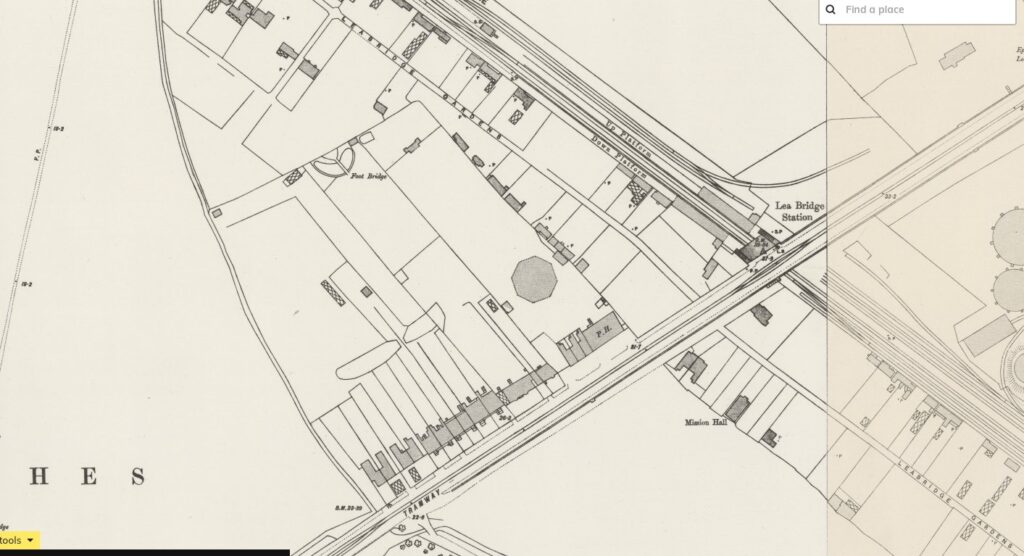
It vanished piecemeal nearly a hundred years ago. The “dwellings” were considered a health hazard by the 1930s. But before the days of building controls, a haphazard development of up to a hundred homes had grown up – Lea Bridge Gardens. Or the Bungalow Town. These were the unofficial homes of the poor.
And because it was all very unofficial there are few surviving records of who came here first, probably not long after Lea Bridge Station opened in 1840, bringing with it some of the earliest housing for commuters in the area. It also brought a direct route from the terminus at the new Shoreditch – later renamed Bishopsgate – Station. For many years this had been an area where newly arrived Londoners settled, often moving on either when they became prosperous or when their attempt at a new life failed. In the 1850s and 60s the silk industry in the area, and many of its workers, often immigrants, moved away to seek new employment. One suggestion is that some of them became the first residents of Lea Bridge Gardens, some of them finding work in the textile, and in particular fabric and yarn dyeing, trade in the area.
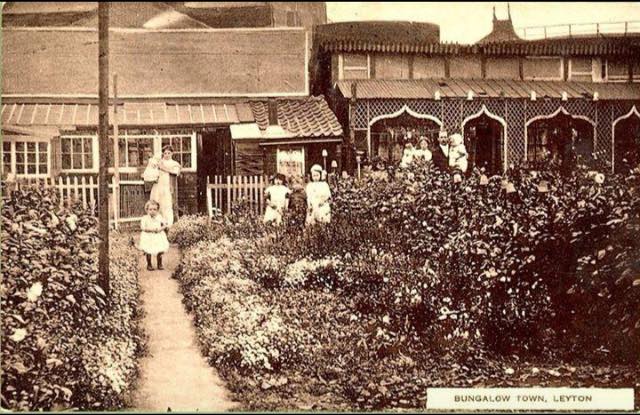
Lea Bridge Gardens in 1893
Whatever made the new residents choose that particular spot, the first houses were of the most basic variety. The Rev’d Morgan Gilbert, then a young curate from Leyton became a regular visitor in the 1880s, and remembered dwellings built round living trees, incorporating the roots and branches as storage for possessions, roofs made of whatever came to hand and trodden earth floors. Morgan certainly believed that the first residents were Spitalfields weavers who “had been driven out of their East End refuges”. Fresh water was available from wells, but the only sanitation was earth closets. There was no heating and none of the dwellings had a proper kitchen. In later years a custom built wooden mission church and school room were set up. But the road was still a dirt one, reached by going under an archway which, for many years, was the only shelter of an elderly hawker and his donkey.
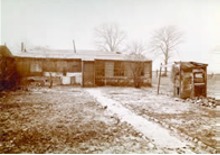
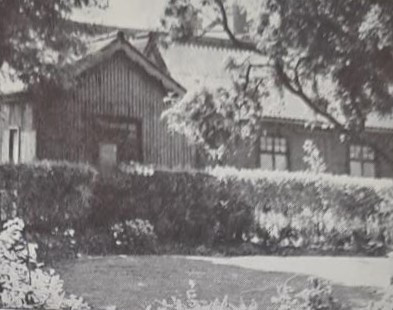
One of the cottages – and its outside earth closet – in c1910
Each dwelling was built of a plot big enough to provide a long garden, and some of the residents made a living by raising vegetables and flowers; some also kept hens and sold surplus eggs. On summer Sundays the children took baskets of flowers up to the Lea Bridge Road and sold them to day trippers on their way to Epping Forest. Morgan remembered children “holding out small bunches and buttonholes, running along by the carts and vehicles of any description, begging for pence in return for a lovely bunch of sweet scented buttonholes or sprays for the ladies”. He remembered, too, that the parish rented one of the cottages as a mission room in those early years, and that they paid for teacher and for books so that the children had at least a basic education.
By the end of the nineteenth century Lea Bridge Gardens was an established community; a photograph shows neat-looking bungalows and well tended gardens. The residents seem to have been a mixed group, still including market gardeners, but also people of a variety of occupations, including a musician, a printer or two and, for a few years, a retired ivory carver from Houndsditch, Richard Kingsman, who had fallen on hard times and had to move in with his son, came into a legacy and so was able to buy a bungalow and, in his eighties, live independently for his last few years. Another suggestion about those years is that tradesmen from Hoxton bought up some of the plots to provide a summer weekend retreat for their families. At least some of the residents were there because that was where they wanted to be and that was how they wanted to live.
One of the cottages, its gardens and its residents looking well settled in c1910
But times changed, and brought with them building controls, medical officer of health reports highlighting the rates of infectious diseases and higher standards of sanitation. In the years after the First World War and, after it, the horrors of Spanish Flu, the authorities began to take an interest in Lea Bridge Gardens. Rather than any draconian attempt at mass eviction, as each bungalow became vacant it was closed down and demolished. By the early 1930s all had vanished, and today no visible trace remai
Three years ago, when I first wrote about the Iron Church, now known as the Stafford Hall, the unpretentious structure that served its community before the present St Barnabas Church, Walthamstow was built, the future of church, vicarage, iron church and church hall seemed moderately uncontentious. Life was hard for everyone in the aftermath of the pandemic. But this was a parish and community with not only a Sunday congregation but many other local supporters, users and droppers-in. Dispiriting, then, to witness the outward and visible effects of present uncertainties.
To begin at the beginning: from damp orchards and watercress beds to a hodge-podge of terraced housing, shops and small factories and workshops was a short journey for an inoffensive field in the last quarter of the nineteenth century. For the area between Boundary Road to the south and what is now Walthamstow High Street to the north, the transformation was especially easy as former common land and once-grand gardens went on the market. And some of what was built survived only a few years, vanishing to make way for higher bidders.
But there are a few places and buildings that have survived unexpectedly, sometimes against the odds. One of these is a smallish and outwardly unprepossessing structure, now dignified with the title of “Stafford Hall”. It has been in turn scout hut, dance hall, a school for “mentally handicapped boys”, cinema and photography club, occasional performance space and pop-up pub. But first of all it was a church.
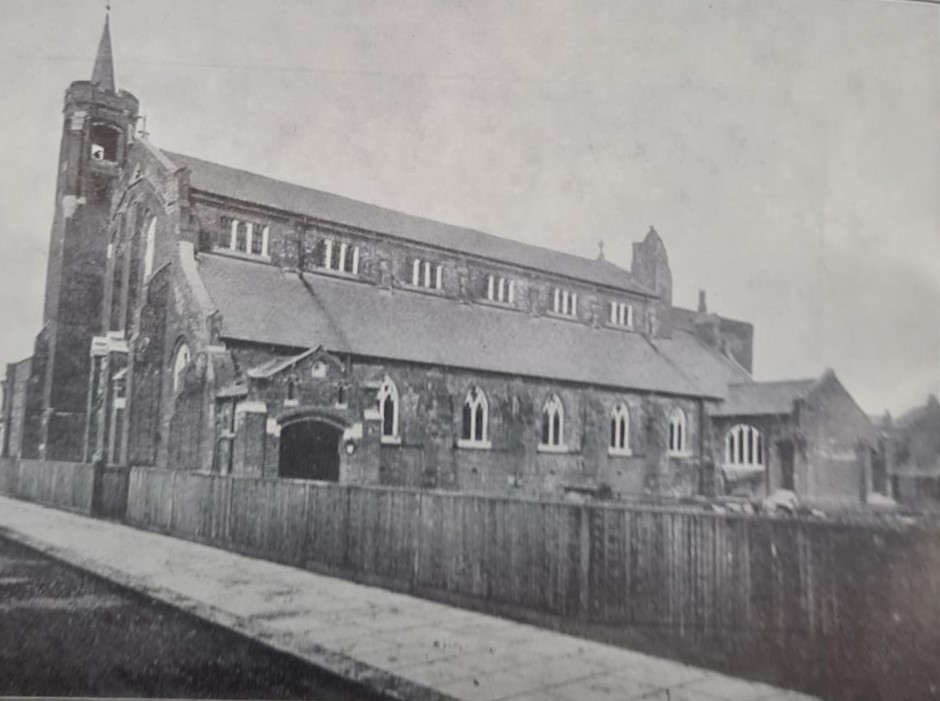
St Barnabas: The Iron Church in 1903, when it was being used for services
Iron churches were not unusual at the turn of the twentieth century; this one was bought second hand for £40 from Battersea, and cost an additional £70 to move and reconstruct. The plot of land that accommodates it as well as St Barnabas Church next door and its vicarage, its garden and the Foster Hall had been donated by H J Casey, city businessman, property developer and owner of The Priory, a grand house in Forest Road. This was a usual piece of philanthropy at the time – Casey, like many others who were making a second fortune from land, might give away a small patch of their profit to provide the ground for a church for the occupants of the hundreds of new houses. Commercial premises were automatically part of the plan, as entrepreneurs scrambled for shop and workshop space. But churches cost – it was a piece of good luck for this now relatively poor area that there was a millionaire philanthropist down the road.
In fact, though, the first ancestor of St Barnabas church was the parlour of Mrs Elizabeth Tracey of Stafford (now St Barnabas) Road. The Traceys’ must have been a busy place in the 1890s, as not only was it home to Elizabeth, her husband Matthew, an iron moulder and their children but the living room in their small house was often used for choir rehearsals, prayer meetings and a Sunday school. Heartbreakingly but not unusually, Elizabeth had borne ten children, of whom only five survived to adulthood – and this was a moderately prosperous family.
But at the end of the decade the Traceys got their house back. The original plan had been to use the plot opposite as a mission church, as was often done in the case of newly built-up areas. Before the 1870s, the nearest church was St Mary’s, a good twenty-minute walk away, mostly across fields in the days before Queen’s Road was laid out to allow access to the new cemetery, opened in 1872. And, contrary to some assumptions about life in the nineteenth century, by no means everyone went to any kind of religious service as a matter of routine, and certainly not if it meant two longish walks.
Closer by, Markhouse Road, or rather Lane, was to become the setting of a large and impressive church largely because of the chance of inheritance. Richard Foster was a City merchant and devout Anglican, and was the heir of his uncle, James Foster, who had lived in a house in Markhouse Lane since the 1830s. On his death he left much of his estate to Richard, who offered some of the land to the Church of England. This was the plot that was to become St Saviour’s, built at Foster’s expense. The architect was T F Dolman, whose design was in the thirteenth century style of the height of the Gothic Revival. Over the next thirty years, Foster was to spend the equivalent of tens of million pounds on building churches both in Walthamstow and other newly expanding suburbs.
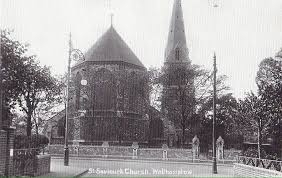
St Saviour’s Church in 1916
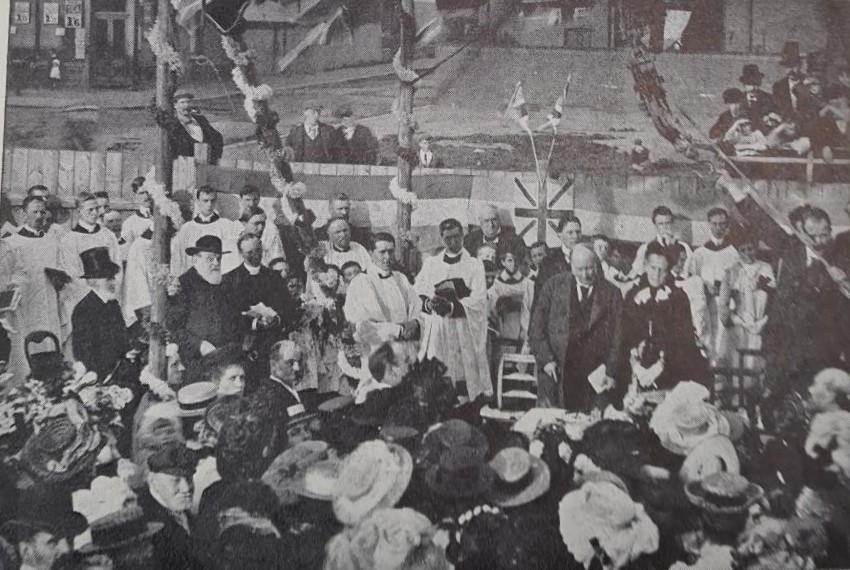
St Barnabas Church was to be Foster’s final church building project. The “Iron Church” was in operation by 1900 – it was realised at the last moment that there was no font, so the newly appointed churchwarden, a mason by trade, made a wooden font overnight. It was then consecrated by the Bishop of St Albans, and remained in use until the permanent structure was ready. Foster took part in a ceremony to “cut the first sod”; there was a lunch afterwards in the iron church. In his speech, Foster said this last project was a thank offering for a life which had held many blessings. He was to live to see the permanent church completed, but made only a modest contribution towards the hall that is named after him.
Richard Foster “cutting the first sod” at St Barnabas on his 80th birthday in 1902
The iron church went on serving as the parish hall for fifteen years after St Barnabas’ Church was completed and the large and elegant vicarage made ready for its first occupants. This was, and is, the grandest house in the neighbourhood, which was a relatively poor one, as it was developed with an eye to housing for the new breed of commuter who travelled on the cheaper workmen’s trains. Rather ironically, one of the first parish magazines, dated February 1905, reports that soup had been made at the Vicarage for the benefit of those who were suffering from “slackness of work”. It was, however, sold for 1d per quart. The recipe is not given.
The original intention had been to take down and sell on the Iron Church and add the plot to the Vicarage garden. But it was eventually repainted and went on to serve as a meeting place and temporary shelter during the Second World War. In 1951 it was leased to Essex County Council “for the training of mentally handicapped boys and men”, and in 1967 it became home to the Walthamstow Amateur Cine Club and, most recently, to a photographic club. By the early 2000s it was cold, in need of repair and most of the furniture was ramshackle. But it was still in use. Meanwhile, next door, while the church escaped the fate of the nearby St James the Greater, demolished in 1960, the years following the Second World War were hard times at St Barbabas.
In recent years the name of Stafford Hall seems to have become official. While it was in continuous use by local clubs and a scout troop, it was less than ideal as a venue, being damp and cold. But after a renewal of local interest and after a coat or two of paint, some repairs and the addition of several sofas, there have been several very popular pop up pubs there, as well as service as a warming room and community shop through two cold winters. It has also been available for meetings and workshops in recent years.
St Barnabas Church when just complete, before the Vicarage and Foster Hall were added
Next door, the vicarage has been home to several succeeding incumbents. One of them, Rev’d Anthony Couchman and his partner Dr Julian Litten, finding their new home run down to the point of dilapidation, spent much time and their own money in restoring house and garden to their former beauty. Although St Barnabas Church escaped sharing the fate of St James the Greater, demolished to make way for a health centre, it and its vicarage had suffered from some years of neglect. When Fr Anthony arrived in 1976, seven people attended his first Sunday service; in 2007, just before his retirement, he preached to a congregation of 123 – his work was with people as well as buildings.
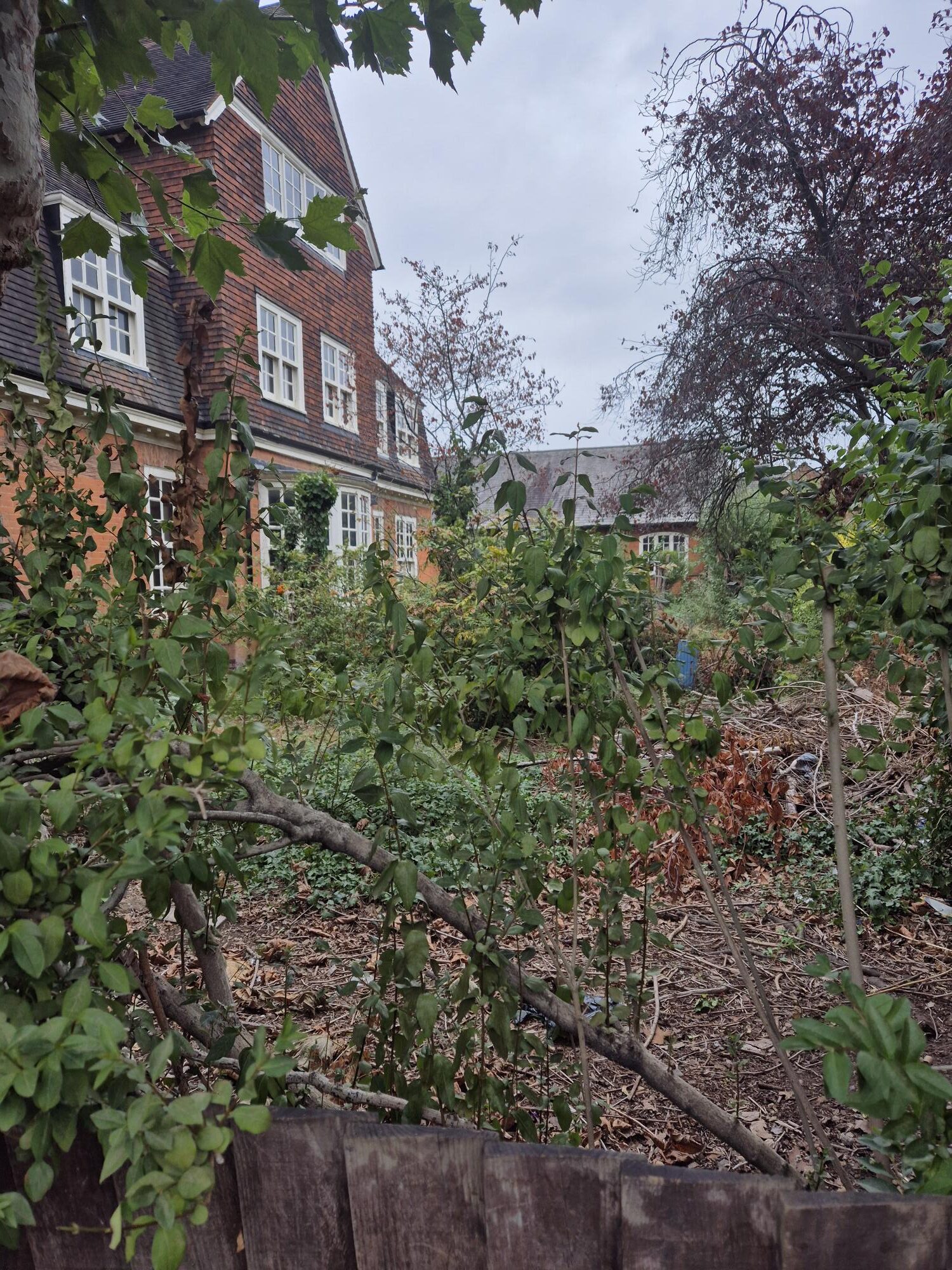
When Anthony and Julian left, it was in the belief that they were passing home as well as church on to their successors. Alas, in the most recent past, the divorced wife of a former vicar was allowed to stay on for several years after a scandalous and highly public break-up. At the time of writing, after her final departure, the vicarage stands empty and the once-lovely garden neglected as, by all accounts, the church hierarchy wrangles over its monetisation. If the reports are true, it is fortunate that a ghostly Richard Foster, surely as generous and kindly in death as in life, is probably unlikely to return to haunt them.
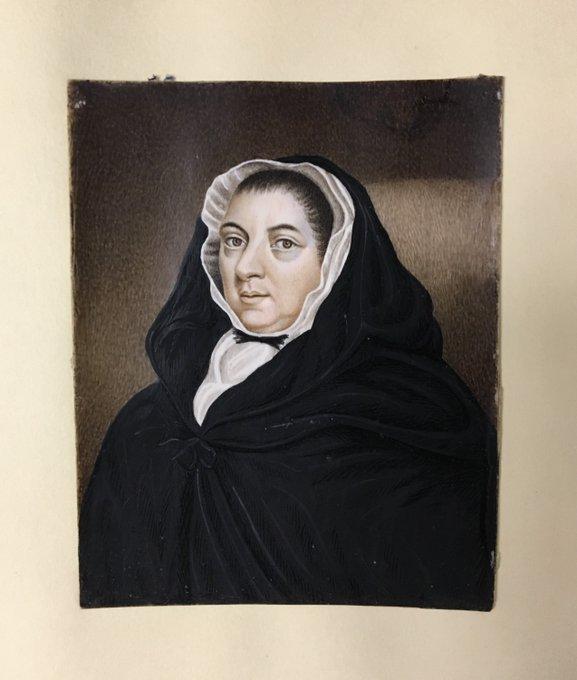
Rose Lok lived to be a very old lady. For a Londoner born in the reign of Henry VIII, to attain the age of eighty-six was in itself an extraordinary achievement. And Rose lived an extraordinary life. She grew up in a house off Cheapside in the heart of Tudor London, one of nineteen children of the King’s own Mercer, William Lok. One of her early memories was of the King inviting himself to dinner. And her later life included not only marriage and children but religious persecution and exile. In her final years she was to write a memoir for her grandchildren.
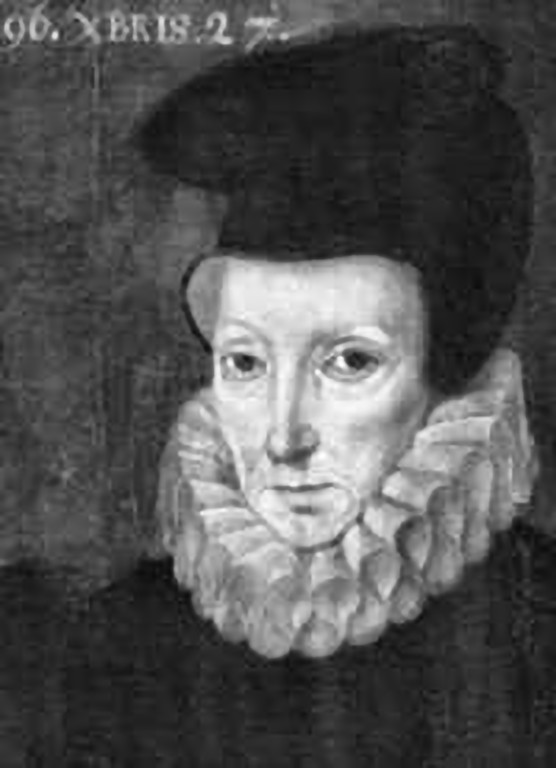
Rose Lok in later life, by a follower of John de Critz
William Lok was a highly regarded mercer who supplied Henry VIII with the latest and most exclusive in of high-end fabrics and trimmings. All through Rose’s childhood, the family was high in the Royal favour. In 1527, the year after William was granted exclusive rights to import fabric for Court revels – a lucrative acquisition, as the “revels” often took the form of lavishly produced events somewhere between a musical and a drunken party, with specially commissioned costumes and props costing the equivalent of hundreds of thousands of pounds. This was in addition to the money he made in a variety of forms of international trade, including importing wine and exporting beer and leather goods. And the Lok family had been high in the Royal favour for many years; there are records going back to 1498 of purchases from them by Elizabeth of York.
The Lok household in Bow Lane must have been crowded. William married four times, but his nineteen children, of whom twelve survived to adulthood, were all born to his first two wives – the second of whom, Rose’s mother Katherine Cooke, died soon after the birth of her tenth child. The deaths of babies and small children was nothing unusual at this time: according to one estimate, two out of five of all those born did not live to see their fifth birthday. And many people approached marriage with pragmatism. It was common for both women and men to marry several times, often seeking a new partner within weeks of being widowed. William Lok’s third and fourth wives were both widows who had been married twice before – their much-married husband probably felt the need for a wife to preside over his houses and care for his many children.
So even by Tudor standards the Lok family was extensive, as was its influence. By the time of his death William Lok owned twelve properties in London as well as land and farms in the home counties. Most of the men of the extended family became mercers, and several Lok daughters married other members of the livery. And the daughters also worked as silkwomen. At this time it was both acceptable and usual for the women of high-status City families to work. In the case of the Loks, and other mercers, this was in the silk trade. There were as yet no silk weavers in England, but raw silk was imported into the country, and was made up into ribbons and trimmings by silkwomen, who would also sell the finished goods to rich and influential customers. This involved having the entrée to Court, and to be one of the accredited silkwomen to the Queen of the day was a coveted status – and one which in turn conferred privileged access, and with it the capacity to form an insider view about the Queen and her household.
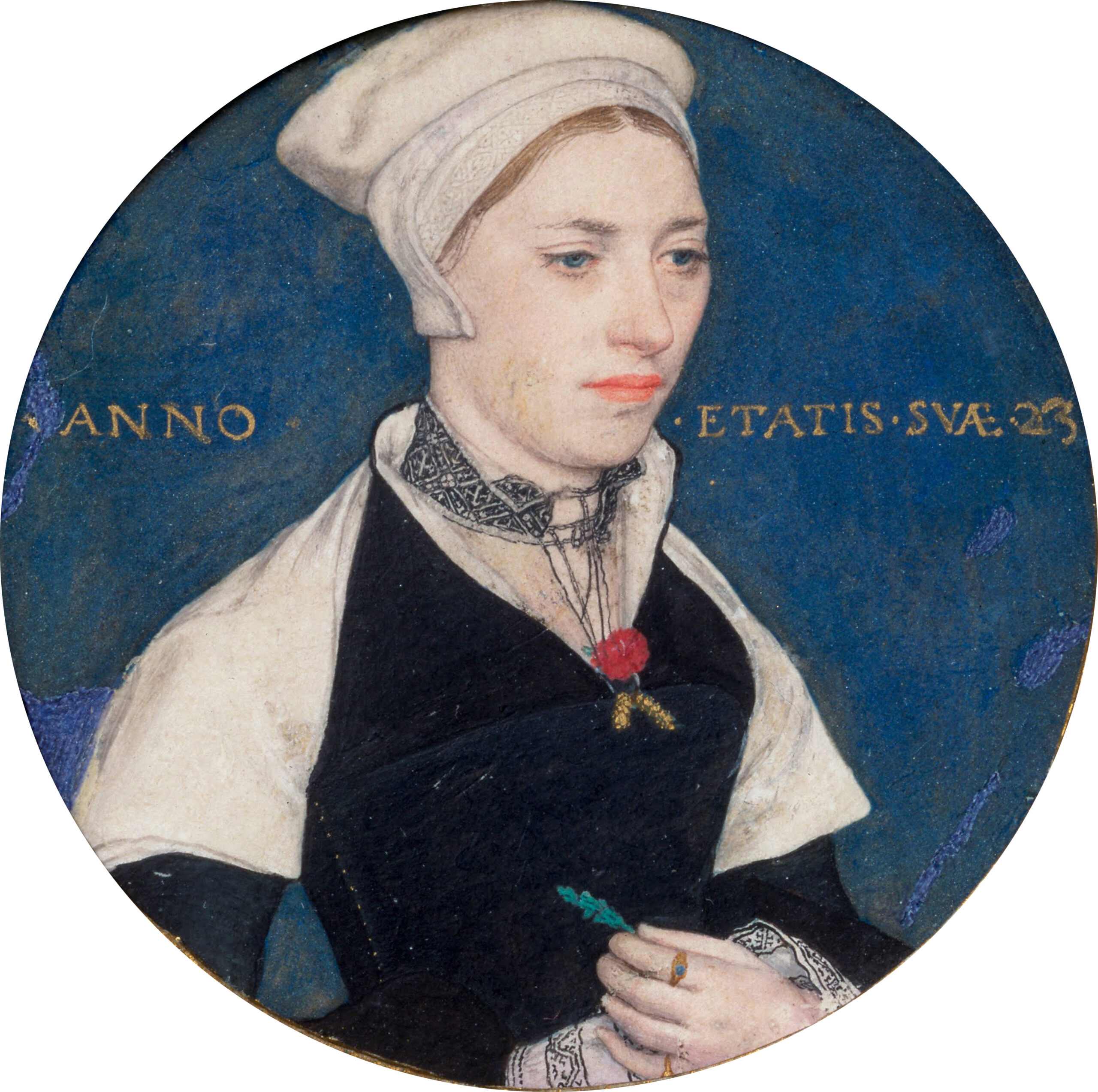
Jane Pemberton, later Small by Hans Holbein. The delicate cords at her neck are likely to have been made by a silkwoman
Rose was to claim in her memoir that her father was importing French religious books for Anne Boleyn and her father and brother by the late 1520s. The whole Lok family were interested, and involved, in the reform movement from its earliest days, long before it was legal to possess a copy of the Bible in English, or French either. As with so much else, if you were of high enough status, it was safe to bend the rules – and the Queen in Waiting could do no wrong. William Lok’s stock rose even higher in 1533 when, on a trip to Dunkirk, he dramatically tore down from the church door a poster proclaiming that the Pope had excommunicated King Henry VIII for refusing to take back Catherine of Aragon as his wife. When this story of loyalty in action reached the King’s ears, it meant a Court appointment as Gentleman Usher and a cash reward for William – and the King started to invite himself to dinner.
William Lok was by no means the first Londoner to find himself entertaining Henry VIII unexpectedly. Ever since he escaped his father’s tutelage when he became King at just short of eighteen, Henry VIII had delighted in moving round London semi-unnoticed. Sometimes this took the form of a set-piece entertainment such as when the King and a dozen courtiers turned up in disguise at a party at Wolsey’s London palace. All the guests knew to join in the game that dictated that everyone was speculating about the identity of the magnificent man in the mask, only to be duly amazed when he revealed himself. Sometimes the expedition was less graceful, such as the forays through London arranged by the King’s friend and Groom of the Stool, William Compton, who was also expected to arrange for pretty and accommodating girls to be available to the King at his own London home. And on yet other occasions the mood was that of the friendly and informal sovereign who asked nothing better than to sit down to an impromptu meal with a loyal servant and his family. Alas that Rose did not record in her memoir any details of the visits – although, as a small girl, she may not have been present for much of the time.
What is clear is that William Lok’s London business was extensive. As mercer to both the King and to Anne Boleyn, he was evidently required not only to supply fabric but to arrange for it to be made into clothes. This is suggested by the large bill that was left unpaid at the time of Anne Boleyn’s death. It was usual in the sixteenth century for the nobility to pay for goods several months in arrears, and the Queen was evidently no exception. In the period between the beginning of January and 27th April 1536, Anne had bought goods priced at £124 15s 2d (multiply by around 500 for some idea of modern values). The itemised list includes a sumptuous range of clothes, from a russet velvet gown trimmed with black lamb’s wool to black velvet night gowns (to be worn informally rather than in bed) to carnation satin sleeves, thirteen kirtles, the fabric for eight pairs of black velvet shoes and a number of items for the Princess Elizabeth. The fact that the bills are for clothes and not just fabric suggests that Lok may well have been involved in the making of the clothes. Some items would certainly have been made by the King’s Tailor, but it is also likely that the Loks’ sphere of influence included tailors and seamstresses who did at least some of the cutting and sewing.
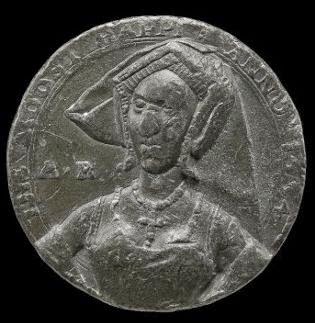
Anne Boleyn at the time of her coronation – this medal is the only authentic surviving image that can be proved to be of her. Most of her portraits were destroyed at the time of her death; many new pictures were made after the accession of her daughter Elizabeth I
Stephen Vaughan, who was a merchant venturer and who was so keen to persuade Anne Boleyn to employ his wife that he provided some free samples of her work – to no recorded avail. Those who were appointed as silkwomen to the Queen were expected to visit her and her ladies regularly with the latest in trimmings, ribbons and tassels, some made by themselves and some imported. The silkwomen were familiar figures, and evidently were often on friendly terms with their Royal customers – and on hand to see and hear what was happening in their households. Twenty years after Anne’s death, at the beginning of the reign of her daughter Elizabeth, some of those whose memories went back far enough made haste to place on record their memories of Anne’s household. And the Loks and their circle certainly contributed a share to the recollection of Anne Boleyn as a serious and devout mistress, who ensured her ladies’ behaviour was exemplary, that they sewed for the poor, and that they read and discussed religious texts over their sewing. At this time there was a concerted effort among Protestant Londoners to rehabilitate the reputation of the woman they regarded as having been largely instrumental in bringing about the English Reformation. John Foxe was to quote Joan Wilkinson, another of Anne’s silkwomen, as a source for the description he includes in his Books of Martyrs of the Queen’s charitable activities and the high standards she set for her household.
And it was at this time that Rose Lok and her husband, another mercer, were able to return to London, having prudently moved to Antwerp during the reign of the Catholic Mary I. They had joined several hundred other Protestant Londoners on the far side of the English Channel, aware that their status and prosperity might not save them from the flames of Smithfield. Rose, her husband and children settled back into London life under Elizabeth I – little is known of her subsequent life except that she lived to be a great-grandmother and revered matriarch. And if Rose’s later years were quiet ones, her son William Hickman took on the role of adventurer, travelling to Russia to the court of Ivan the Terrible, and returning safely to tell his mother the story.
There is a stretch of seventeenth century garden wall left to show where the house once stood. One of many hospital carparks takes up the space that was once an ornamental lake, filled in after a nurse drowned. The Samuel Boyce Lodge, described as a “psychiatry elderly unit”, stands on what were once the gardens. The house stood for nearly four centuries before it was demolished and sold to the North East London Metropolitan Hospital Board. Planning regulations were less strict in 1964. Now obliterated by Whipps Cross Hospital, these were once the outskirts of the village of Leyton, between the Phillebrook and James Lane.
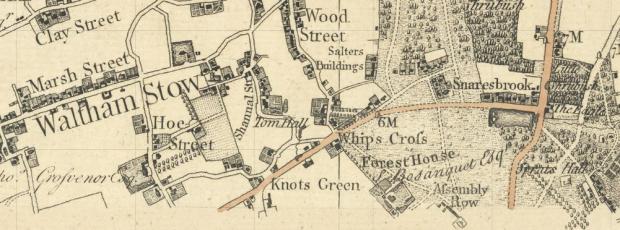
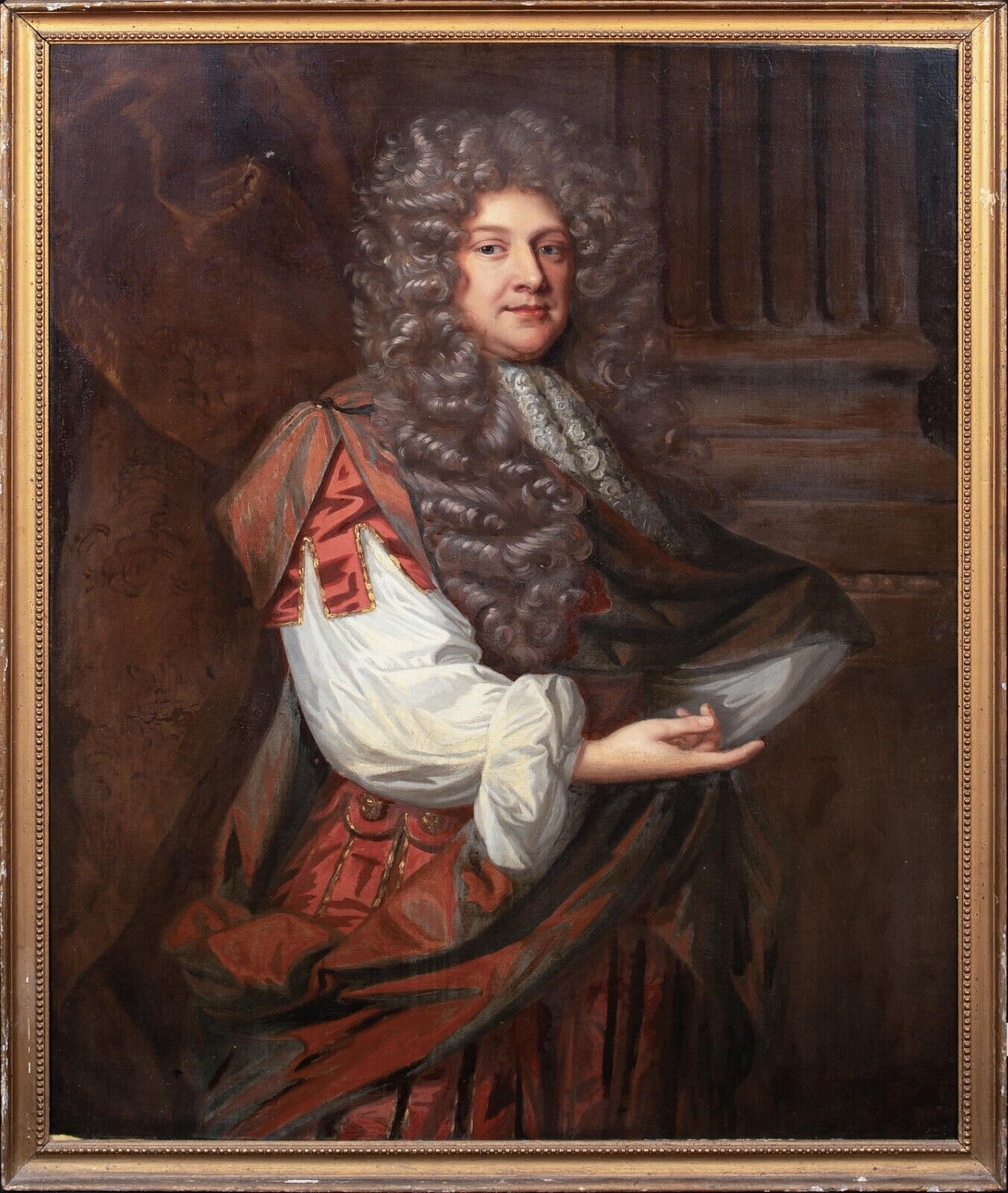
The area is busy with hospital traffic today. In 1492 John More, stockfishmonger, rented twenty acres of land there from the Abbot of Stratford. Over the next century this smallholding grew to an estate of 139 acres, and More’s descendants were among the major landholders in the area. There was a substantial farmhouse by the 1560s, owned in the 1650s by the Royalist Gorings. By this time it contained 23 hearths, and was the largest house in the parish. A Huguenot family originally from Lille whose members had made a fortune in the City, the Houblons, built a new Baroque style house in 1683. John Houblon was to become one of the founders of the new Bank of England; he had made a fortune in the City. He and his brother James were in turn Lord Mayors of London – their grand house in Threadneedle Street was to become the headquarters of the Bank of England, and in later centuries the image of James was to appear on the £50 note. Forest House was at a convenient distance from central London – close enough to be an escape, far enough for peace and fresh air.
The Huguenot, and also the banking connections were maintained when Forest House passed into the ownership of Samuel Bosanquet, another City grandee. The new owner commissioned updates by Sir John Soane, and settled, with his wife Mary, to bring up their children in their elegantly renovated home, which featured no fewer than 80 windows, with Bosanquet’s initials carved into several room schemes. It was evidently a shock when their daughter Mary became a Methodist – their parents banned her from the house as they did not want her to convert her brothers to her faith. But Mary Bosanquet was not to be deterred. She became well respected in Methodist circles, correspondent with John Wesley and at length secured a preaching licence – a great accolade for a woman. In later years Mary and her parents were reconciled, and she lived, and opened a children’s home, at one of the family properties in Leyton. It was not until 1831 that the Bosanquet family began to rent out Forest House, and for the next fifty years it was home to a series of merchant families, including William and Rachel Fowler and their eight children.
But by the last years of the nineteenth century the railways had arrived, London was growing and Leytonstone and its neighbours were becoming less fashionable. And Forest House, like many other once-elegant homes, went up for sale, and in 1889 Samuel Courthope Bosanquet found a buyer for the house and most of the estate – the West Ham Union. By this date, two generations on from the days of Oliver Twist, the duties of the guardians of the union workhouses had become far more exacting than those of their predecessors. It was no longer acceptable to provide the needy only with the most basic levels of food and shelter. By now there was at least some humanity in the assistance provided; the oldest, the youngest and the infirm, at least, were no longer blamed for being in need. Schools were provided, as were hospitals, with the beginnings of humane treatment for people who were still termed “lunatics”. The West Ham Guardians were planning for several new facilities: the existing workhouse at Leyton was overcrowded, and among the plans they made was to turn Forest House into an annexe.
So it was that in 1894, after some renovation work, the first 128 of the new residents of Forest House arrived in brakes. They were all over 70, had been hand-picked as being among the “best conducted” inmates, and included 89 year-old James Hennessy, who had taken part in the Charge of the Light Brigade nearly half a century before. Newly built hospital facilities followed – these were completed in 1903, only to become a military hospital for much of the First World War. Forest House continued to be used as an old people’s home, with, as time went on, additional provision for those in need of psychiatric care. Nearby, Whipps Cross Hospital has grown apace.
No one seems to have recorded how it came about that in 1964 Forest House was demolished, and the site sold to the North East London Metropolitan Hospital Board. By that time the National Health Service had been in existence nearly twenty years, but still, in the 1960s, not only hospital trusts but local authorities and other entities were still getting away with what would now be regarded as an outrageous lack of responsibility around the buildings in their care. It is now far too late to save, or even to record much about what should have been cherished as a unique part of the history of its area. But hospitals are notoriously haunted places, and it is tempting to wonder about some of the shadows around what is now the Samuel Boyce Lodge.
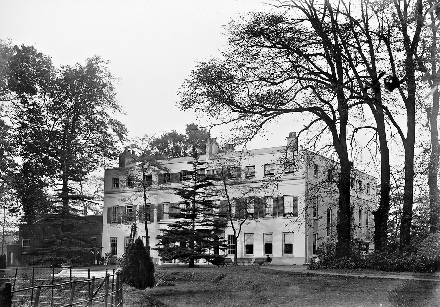
It didn’t look Tudor at all. I walked past two or three times thinking this couldn’t be right, but then decided this must be the Sutton House I had come to see. Half of it was rendered, the forecourt was paved, the windows were clearly eighteenth century, there was a 1930s noticeboard about its acquisition by the National Trust, and the only clue to a Tudor past was one of the two front doors. Inside, the house was both grubby and tatty. There were people handing out leaflets, a serious-looking lady dispensing tea and cake, and, in the courtyard, a bearded man waving his arms and exhorting a small group of followers about maps.
It was a close-run thing. It would have been easier to accept a leaflet, drink a hasty cup of tea and leave. But I didn’t. And I was one of the people who ended up fighting for a better future for for this bedraggled survivor of five centuries of change. It nearly didn’t make it, threatened, by the late 1980s, not with demolition but with gentrification. When the house was new, in the 1530s, it was part of a semi-rural community where residents built second homes away from the pressures of the City three miles away. Ralph Sadleir, a young man on his way up in the world, had managed, still in his twenties, to fund a new brick-built house for his young family.
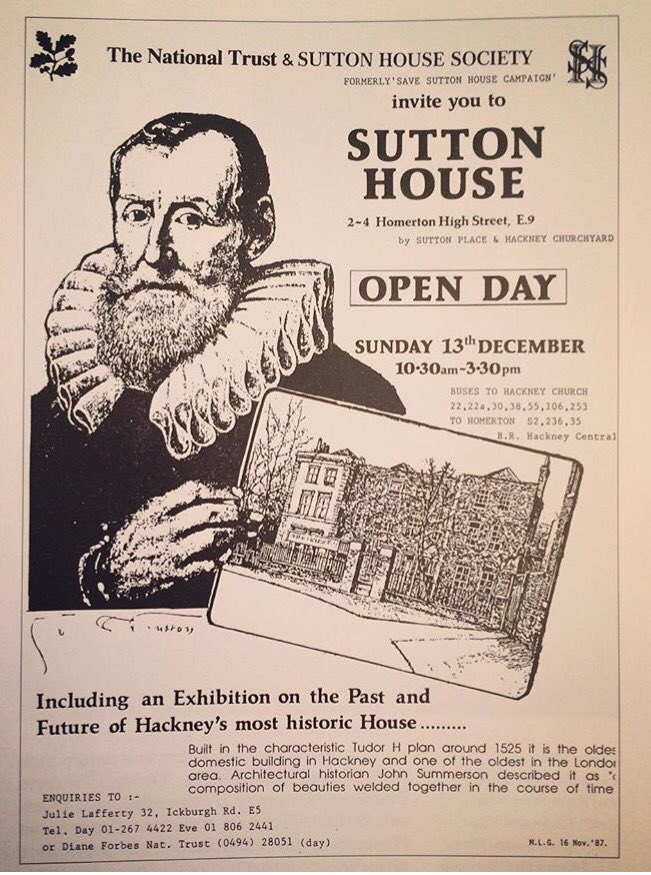
Poster for the first open day in December 1987
But none of us knew that then. At the time of the Save Sutton House campaign it was still accepted that this was once the home of Sir Thomas Sutton. Or maybe Sir Julius Caesar. And possibly involving one of several semi-Royal Hackney residents, always supposing we have eliminated the assorted hangers-on of Christopher Urswick, Rector of Hackney, once the almoner of Margaret Beaufort and latterly the centre of what he would hate to be remembered as a group of reformers. But we know that Desiderius Erasmus, famed theologian, was also famed as a freeloader, and tracked Urswick down to Hackney in search of the price of a new horse, but Urswick then in his 70s, was out hunting, and so not available for cadging. But that’s a very old story.
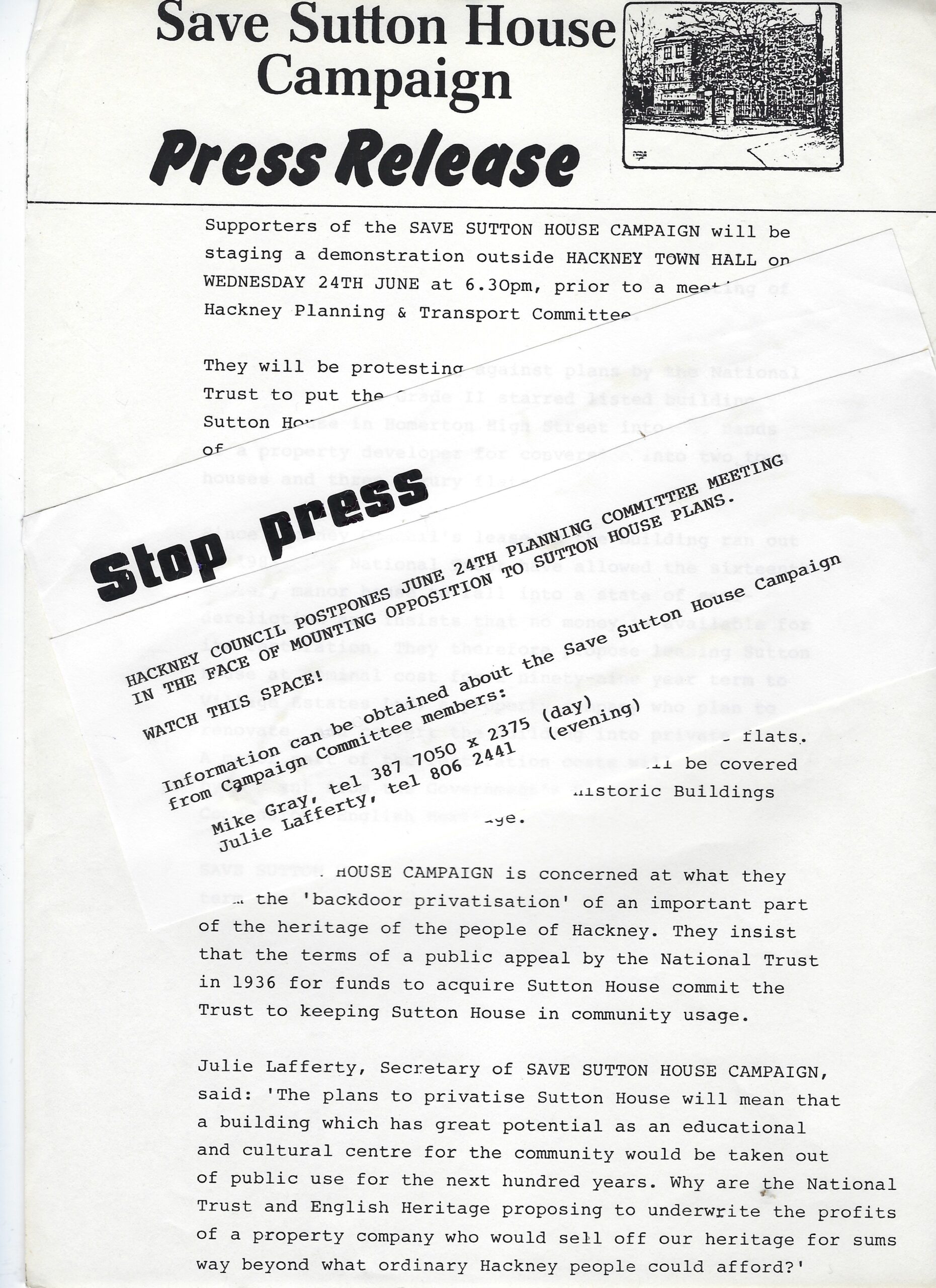
It took months of campaigning, several petitions and a lot of publicity to persuade the National Trust they were not going to get away with allowing this unloved property to be turned into five luxury flats that would then be open to the public only once a year. The local authority had been approached with the suggestion that Sutton House should become a museum, but councillors had responded that it would be better if this piece of “built imperialism” were to be “razed to the ground”. The National Trust and its chosen developer had then gone ahead with making a planning application for the flats scheme, and this got as far as a listing in the Hackney Gazette. It was seeing this that persuaded some half-dozen local residents first to respond to and then to resist the plans.
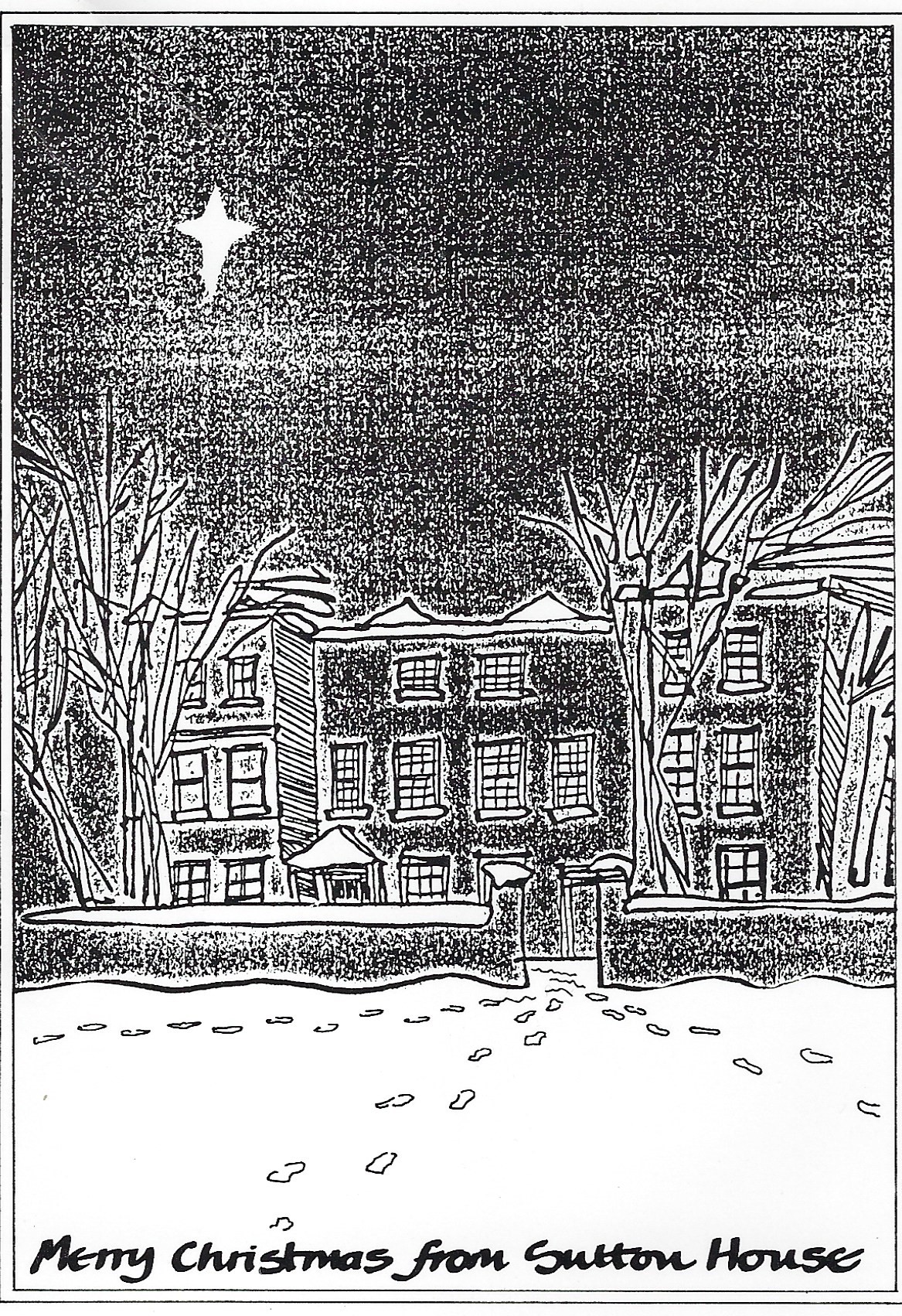
Early fundraising included home-made Christmas cards
So it was that the Save Sutton House campaign was born. From fairly chaotic beginnings, the outline of a plan to restore and open the house for community use came into being. By late 1987 there was enough common ground between the campaigners and the National Trust to allow a jointly organised open day to take place. Such was the level of local interest that, in response to a publicity effort that largely consisted of A5 black and white posters attached to trees, some 800 people visited. And this was just the beginning.
Over the next few months it was agreed that Sutton House should be restored, the work to be paid for from grant funding, and the house then made available for a variety of education, arts and commercial uses, the historic rooms to be open to visitors for some of the week, a café bar opened, and the whole scheme to be jointly managed by the National Trust and the Sutton House Society, presided over by a Local Committee elected by both organisations. A project manager and fundraiser were appointed, along with an architect. A structure of sub-committees was agreed upon, with the membership of each drawn from both organisations. The restoration was to take place in two phases, to be completed by early 1994.
Petition and demonstration, 1988
It is hard to over-state how radical this scheme was at the time of its inception. In the last decade of the twentieth century, the word Hackney still spelled decay to much of the world. Books with titles involving the word “ruins” set out the perceived awfulness, poverty and hopelessness of the East End in general and Hackney in particular. If anyone from what was then still Fleet Street wanted an example of urban decay, all too often a reporter and a photographer would venture up the City Road and make sure they found what they were looking for. As to the National Trust, many of its senior employees were tentative about visiting Hackney, and its was only a few years since James Lees-Milne had recorded his distaste for both the property and its surroundings. One memory of this time involves three of them emerging from Sutton House, with one asking the others “where d’you get lunch this side of the Limpopo?”. We all had a lot to learn.
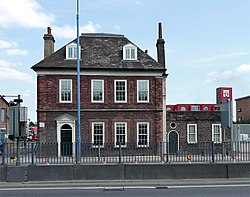
The northern approach to the Blackwall Tunnel isn’t the most inspiring landscape. A building on the left not far from the big Tesco’s near Bromley by Bow looks to the casual glance like, perhaps, an Edwardian public library or maybe a business headquarters that has had an adventurous life.
It’s been a lot of things: home, hospital, gunpowder factory, business headquarters, children’s hospital, show place, lover’s trysting place, church office, palace. A thousand years ago there were three mills hereabouts – hence the name of the area. Seven hundred years ago the vastly rich Holy Trinity Priory, Aldgate owned the building and the lordship of the Lower Manor of Bramberley – until Henry VII “acquired” it as a hunting lodge.
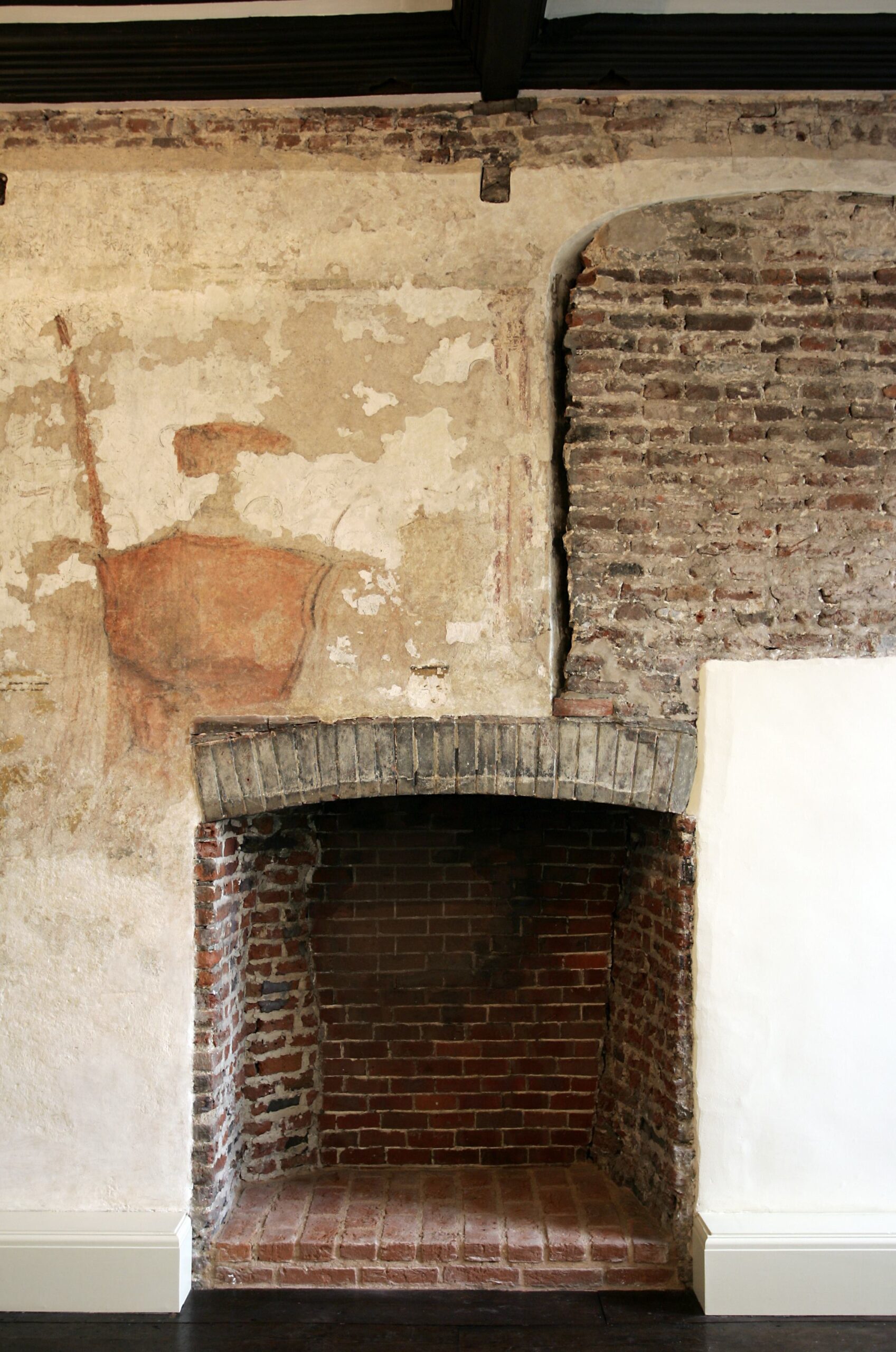
We now know that in the early Tudor years this was an exquisitely decorated mini-palace where courtly hunting parties waited for the tide to be right for their return by boat to Greenwich. When the present-day building was restored a few years ago, discoveries included the remains of exquisite trompe l’oeil wall paintings of men at arms keeping guard over the landscape, of elaborate lettering, and of door frames carved with hunting scenes.
Early in the reign of the young Henry VIII the courtier John Blount had a short lease on the building for a few years. It is likely that Blount’s name would no longer ring many historical bells if it were not for the fact that he was the father of a daughter who became a lover of the King. Elizabeth Blount, generally condescendingly known as Bessie, was a maid of honour of Catherine of Aragon, became a Royal mistress and was tactfully retired to the country when she became pregnant. Her son, Henry Fitzroy, was acknowledged, brought up in some splendour, and his mother married off to two minor aristocrats in succession. Bessie and her former lover remained on good terms, and presumably her father, too, took the line of least resistance – certainly he was one of the retinue that accompanied the King to the Field of the Cloth of Gold, and lived on to become a member of parliament.
Trompe l’oeil wall painting of archer – c1500
The fortunes of Bromley Hall in the next few years were complicated. By the time of the Dissolution of the Monasteries in the late 1530s both the house and the surrounding land were up for grabs. And one of those best placed to do the grabbing was Ralph Sadleir, builder of Sutton House in Hackney. We know from his account book, meticulously kept by his steward Gervase Cawood, that some of his plummiest acquisitions, perfectly legal and approved by the Court of Augmentations, included properties around Bromley Hall. There is some evidence that the former tenants, evicted as a result, came to Hackney to protest.
By 1550 Sadleir had disposed of his property in the London area, Bromley Hall included – by this stage he was well on the way to the status he finally achieved – that of the richest commoner in the country. Both Sutton House and Bromley Hall lost their Court connections but remained very desirable properties. In 1606 Bromley Hall was acquired by Sir Arthur Ingram, who was on the staff of Sir Robert Cecil. Among Ingram’s duties was selling Crown lands to City merchants – so, in that respect at least, little change there.
The next two centuries saw many changes of owner and of use for Bromley Hall. Most of those owners were a series of City merchants, some of whom came to live, while others used the building for commercial purposes. It was to become a gunpowder factory in the civil wars, the headquarters of a calico printing works run by a Quaker dynasty and a paediatric training hospital. This was a relatively small, adaptable and useful building, so it continued to escape demolition. It was not until the early years of the present century that it was restored, and is now used as office space, owned and managed by Leaside Regeneration.
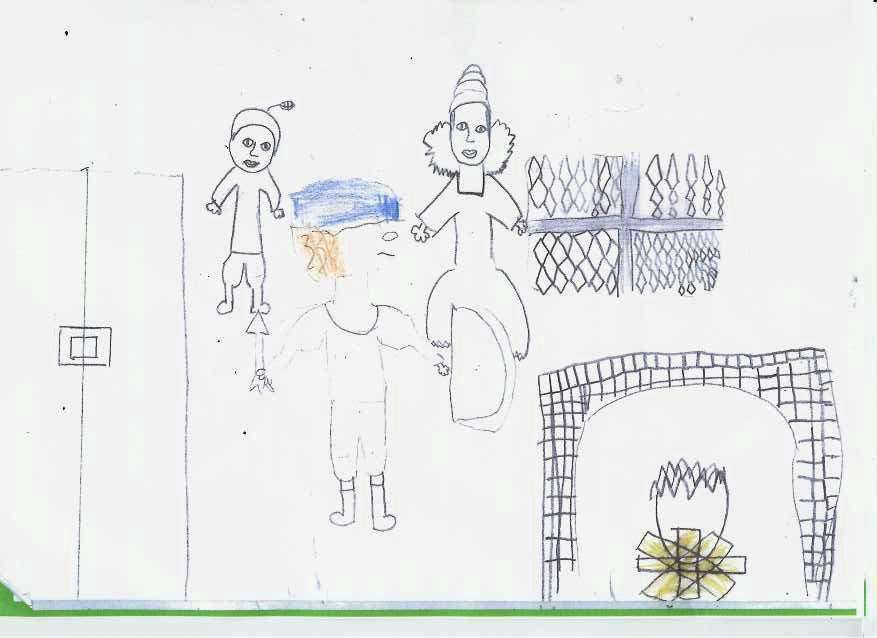
A ten-year-olds response to Bromley Hall
When we were able to visit with a group of local young people, we were amazed by how strongly we are able to imagine the place and people of the early Tudor years who partied and picnicked here as they waited for their boat back to Greenwich. We created our own version of a visit in the 1530s as Ralph Sadleir planned to add this mini palace to his expanding property portfolio. We reimagined the area as hunting land, and returned to Hackney full of ideas for the delegation that did, we believe, visit Sadleir to persuade him to allow his tenants to stay in the land they had farmed for generations.
As far as we know there is no current public access to this magical place. We hope the present owners will take forward their plans to invite their neighbours in.
From damp orchards and watercress beds to a hodge-podge of terraced housing, shops and small factories and workshops was a short journey for an inoffensive field in the last quarter of the nineteenth century. For the area between Boundary Road to the south and what is now Walthamstow High Street to the north, the transformation was especially easy as former common land and once-grand gardens went on the market. And some of what was built survived only a few years, vanishing to make way for higher bidders.
But there are a few places and buildings that have survived unexpectedly, sometimes against the odds. One of these is a smallish and outwardly unprepossessing structure, now dignified with the title of “Stafford Hall”. It has been in turn scout hut, dance hall, a school for “mentally handicapped boys”, cinema and photography club, occasional performance space and pop-up pub. But first of all it was a church.
St Barnabas: The Iron Church in 1903, when it was being used for services
Iron churches were not unusual at the turn of the twentieth century; this one was bought second hand for £40 from Battersea, and cost an additional £70 to move and reconstruct. The plot of land that accommodates it as well as St Barnabas Church next door and its vicarage had been donated by H J Casey, city businessman, property developer and owner of The Priory, a grand house in Forest Road. This was a usual piece of philanthropy at the time – Casey, like many others who were making a second fortune from land, might give away a small patch of their profit to provide the ground for a church for the occupants of the hundreds of new houses. Commercial premises were automatically part of the plan. But churches costed – it was a piece of good luck for this relatively poor area that there was a millionaire philanthropist down the road.
In fact, though, the first ancestor of St Barnabas church was the parlour of Mrs Elizabeth Tracey of Stafford (now St Barnabas) Road. The Traceys’ must have been a busy place in the 1890s, as only was it home to Elizabeth, her husband Matthew, an iron moulder and children but the living room in their small house was often used for choir rehearsals, prayer meetings and a Sunday school. Heartbreakingly but not unusually, Elizabeth had borne ten children, of whom only five survived to adulthood – and this was a moderately prosperous family.
But at the end of the decade the Traceys got their house back. The original plan had been to use the plot opposite as a mission church, as was often done in the case of newly built-up areas. Before the 1870s, the nearest church was St Mary’s, a good twenty-minute walk away, mostly across fields in the days before Queen’s Road was laid out to allow access to the new cemetery, opened in 1872. And, contrary to some assumptions about nineteenth century history, by no means everyone went to any kind of religious service as a matter of routine, and certainly not if it meant two longish walks
Markhouse Road, or rather Lane, was to become the setting of a large and impressive church largely because of the chance of inheritance. Richard Foster was a City merchant and devout Anglican, and was the heir of his uncle, James Foster, who had lived in a house in Markhouse Lane since the 1830s. On his death he left much of his estate to Richard, who offered some of the land to the Church of England. This was the plot that was to become St Saviour’s, built at Foster’s expense. The architect was T F Dolman, whose design was in the thirteenth century style of the height of the Gothic Revival. Over the next thirty years, Foster was to spend the equivalent of several million pounds on building churches both in Walthamstow and other newly expanding suburbs.
St Saviour’s Church in 1916
St Barnabas Church was to be Foster’s final church building project. The “Iron Church” was in operation by 1900 – it was realised at the last moment that there was no font, so the newly appointed churchwarden, a mason by trade, made a wooden font overnight. It was then consecrated by the Bishop of St Albans, and remained in use until the permanent structure was ready. Foster took part in a ceremony to “cut the first sod”; there was a lunch afterwards in the iron church. In his speech, Foster said this last project was a thank offering for a life which had held many blessings. He was to live to see the permanent church completed, but made only a modest contribution towards the hall that is named after him.
Richard Foster “cutting the first sod” at St Barnabas on his 80th birthday in 1902
So the iron church went on serving as the parish hall for fifteen years after St Barnabas’ Church was completed and the large and elegant vicarage made ready for its first occupants. This was, and is, the grandest house in the neighbourhood, which was a relatively poor one. Rather ironically, one of the first parish magazines, dated February 1905, reports that soup had been made at the Vicarage for the benefit of those who were suffering from “slackness of work”. It was, however, sold for 1d per quart. The recipe is not given.
In recent years the name of Stafford Hall seems to have become official. There have been several very popular pop up pubs there, and at the time of writing it is, after a coat or two of paint and the addition of several sofas, seeing service as a warming room.
St Barnabas Church when just complete, before the Vicarage and Foster Hall were added
At the turn of the nineteenth century, Hoe Street was still a well kept suburban road. The houses along each side were spacious, so were the gardens – these were on a less grand scale than country houses in the shires, but needed perhaps half a dozen indoor servants to run, with gardeners, grooms and coachmen too. This was the leafiest of suburbs.
Hoe Street was home to people on their way up or down in the world, usually as they made or lost a fortune in the City. This was certainly true of The Chestnuts in the late eighteen and early nineteenth centuries. Many residents only stayed a few years, often moving on to a grander, more permanent home – if their luck in the games of City snakes and ladders held good. In some cases, little is known what later became of them. The house they lived in remains, in many respects, little changed.
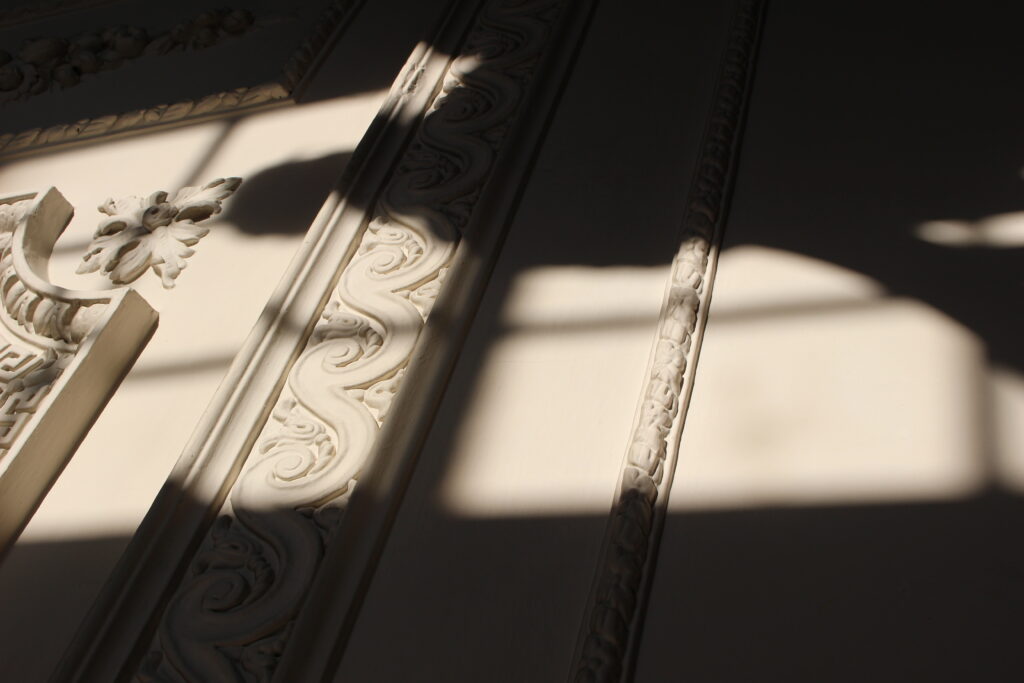
Detail of the original plasterwork on the main staircase
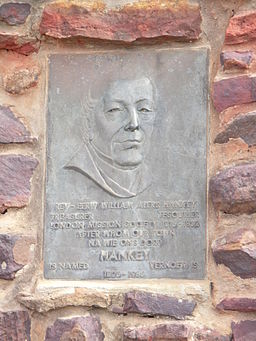
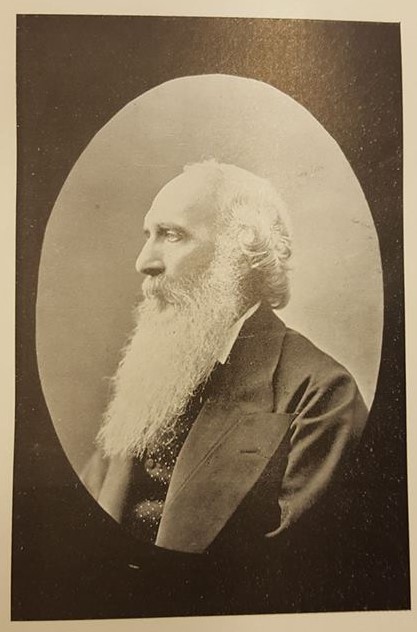
One of the better documented is William Alers Hankey, much respected in his time, but whose memory is less than comfortable for some. Born in 1771, the son of Thomas Hankey and a Miss Alers who was probably the governess in his household, Hankey was educated at the University of Edinburgh, returning to London to enter his father’s bank. He was evidently a successful businessman, and gained his father’s esteem to the point of being allowed to add the surname Hankey to his original name of William Alers. He lived first in Hackney, later taking on the tenancy of The Chestnuts. He had married Maria Martin, the daughter of a colleague, and he settled down to being a domestic tyrant, requiring his daughters to address him as “Mr Papa”. Hankey was instrumental in the missionary society movement, and a co-founder of the Foreign Bible Society – there is a town named after him in the East Cape.
A memorial to William Ayers Hankey is still in place in the East Cape
Hankey was among those who claimed to support the abolition of slavery. He appeared before a Commons Select Committee maintaining that he wanted to free the 300 slaves he owned on the Jamaica sugar plantation his company had acquired via a mortgage default. However, he considered that preparation was needed because the condition of enslavement was degrading so enslaved people needed religious instruction before they were fit to deal with freedom. He had bought and sold slaves as late as the 1820s. When compensation was allocated in 1837, Hankey’s share was £5,777 8s 0d (the equivalent of at least £1.5M today). He died, aged 88, worth £250,000 – multiply by at least 150 for modern values: a multi-millionaire.
Hankey’s successor at The Chestnuts was another City merchant, but a very different character. Mr Powell, a merchant of Mincing Lane moved his family into the Chestnuts in 1854. Among his children brought up there was his son, Frederick, a delicate boy whose life was often despaired of. But he lived to grow up, studying Anglo Saxon at Oxford, later becoming Regius Professor of Modern History and helping to found Ruskin College. He described himself as a “socialist and a jingo” politically, and a “decent heathen Aryan” in terms of religion.
The last family to live in The Chestnuts were the Reads. John Read had been born in Jamaica, the child of relatively poor parents – his father was working in a clerical job. He was sent home aged only four months to live with his grandparents in Woolwich – the young John went on to become a successful stockbroker, putting aside his musical ambitions until he had made enough money to marry and then to settle his wife and six children in a substantial house in Walthamstow, first in Marsh (now High) Street, then moving to the Chestnuts, where they were to stay over twenty years.
J F H Read, as he was usually known, became noted in the area, where he served as a JP, as a supporter of many charities, as the Chair of the Schools Board and in church circles – he was a church warden of the then newly built St Saviour’s Church. Now with time to spare to devote to his music, Read played the viola in the Stock Exchange orchestra, and began to compose music; many of his pieces were played by the orchestra of the Walthamstow Musical Society. Lacking a venue big enough for his orchestral pieces, Read put up the money to build the Victoria Theatre in Hoe Street – it occupied the area where the Granada cinema now stands. Read was also churchwarden at the newly built St Saviour’s Church, and wrote many pieces to be played on the organ there.
J F H Read, photographed in the 1890s
In the time it was the home of the Read family, The Chestnuts was run on comfortable lines, with a domestic staff including a cook, two housemaids, a general servant, a coachman and a stable keeper as well as a governess and nursemaid listed in the 1881 census. Two of the sons were away, presumably at school, on census night, but four of the Read children were at home. This was a house with twelve main bedrooms as well as servants’ rooms on the second floor. Ten years later, the 1891 census lists a similar number of servants, but the governess has departed as all the children are now grown up. As this was a time when all heating was by open fire and coal and hot water had to be carried, this was a fairly modest staff to run it. There were also extensive gardens, running southwards to Boundary Road and westwards to Chelmsford Road. No gardeners are listed in the census, but it is likely that at least one gardener was employed but lived elsewhere.
Read’s obituary tells us he died “a comparatively poor man”. Certainly, although he retired at least twice but returned to work to top up the coffers, he finally gave up The Chestnuts and moved to a house with only eight bedrooms. The 1901 census return, taken just before his death, finds him widowed and living in Wanstead with three of his daughters, two nurses, a cook and a house parlourmaid. His eldest daughter Mary is now listed as a professional musician – she was to go on to have a successful singing career in the years following her father’s death.
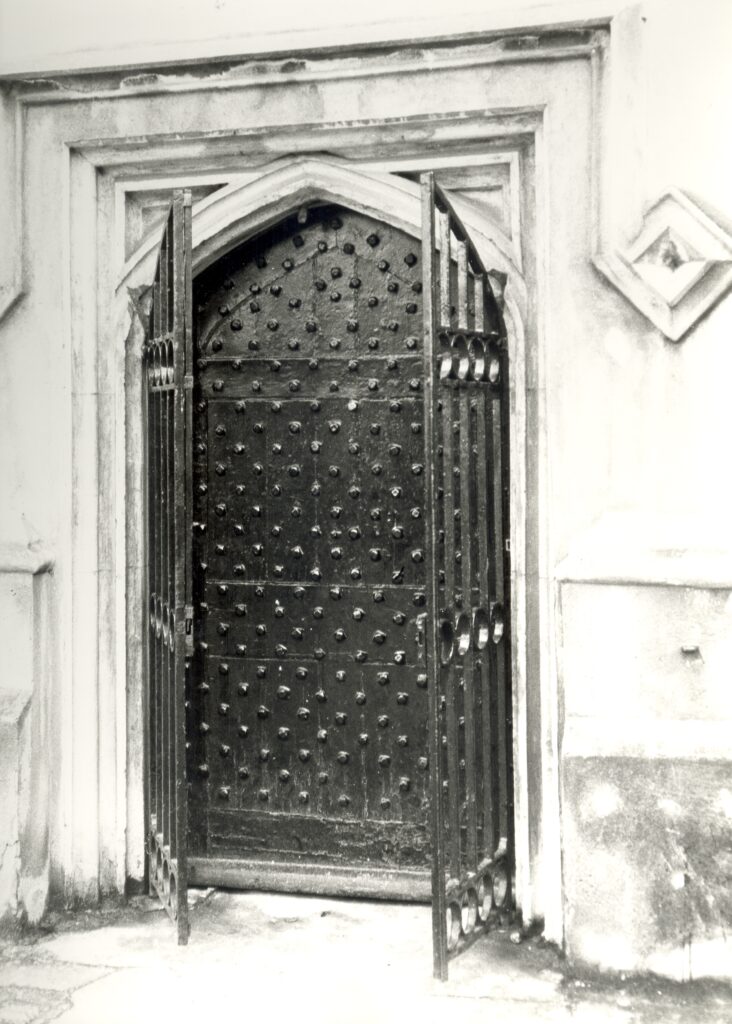
It is sad that Read is scarcely remembered in Walthamstow, despite his years of service and of philanthropy. His grave, in Queen’s Road Cemetery, was resold in the 1970s and is covered with a memorial to the new owners. The Chestnuts was sold to the local authority, and was used for twenty years as a mental hospital – in the terminology of the time a “woman’s lunatic asylum”. Minimal alterations were made for its new use, but these included nets under the first floor landing so as to reduce the risk of any patient throwing herself downstairs. The house has been used for a variety of educational purposes through much of the twentieth century, but is currently lived in by property guardians
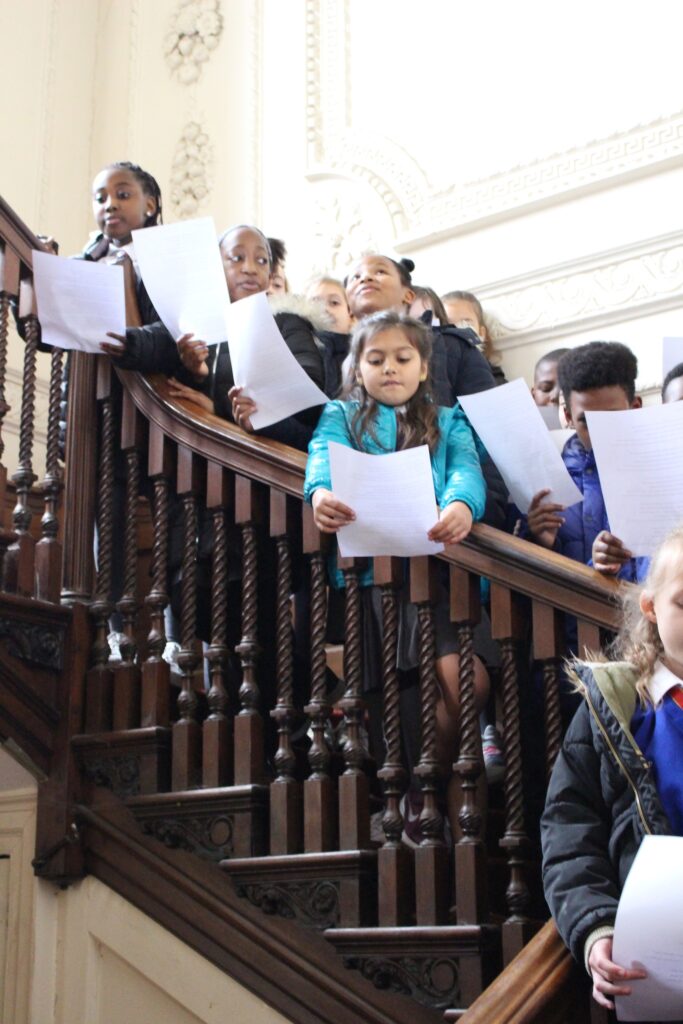
Local schoolchildren rehearsing on the main staircase at The Chestnuts
The Chestnuts belongs to the people of Waltham Forest, and after multiple false starts, there is still no sign of a plan that will restore this precious survival, currently badly neglected, and ensure it is made accessible to everyone. Just before the pandemic Clio’s Company arranged some school visits, events and an open day. On just one afternoon there were over 400 visitors of all ages. A “to let” sign went up in early 2022. Now, in September, it is still there.
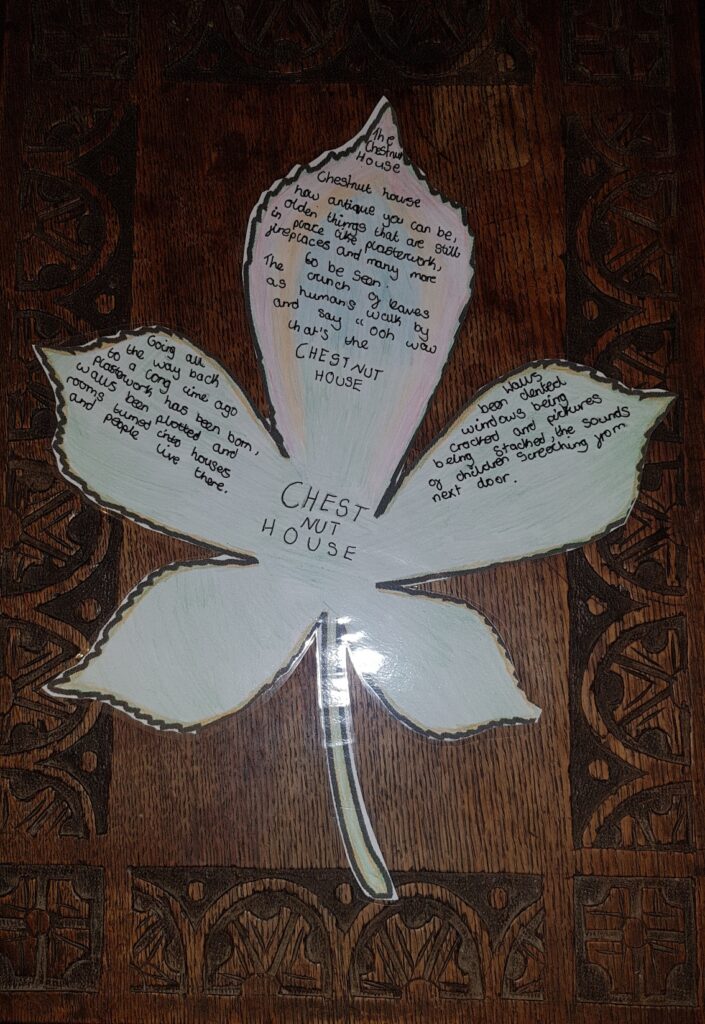
Poem written and presented by one child in response to a visit to The Chestnuts
A time traveller going back five centuries would be likely to get lost In Walthamstow. St Mary’s Church is in the right place, but is a different shape, inside and out. The Ancient House is more reliable, but lacks a wing, is weatherboarded and surrounded by farmland. Hoe Street is there, without a single chicken shop, and fringed with substantial houses set back from the road.
St Mary’s Church, Walthamstow
This was a desirable place to live, with good farmland, but within easy reach of London. In the 1520s there were 99 taxpayers, which probably indicates a population of about 400. And by the sixteenth century Walthamstow was home to a number of City merchants. One of the most influential was Sir George Monoux, a draper and former Lord Mayor London who bought a large house and estate just outside Walthamstow. He was generous to his new community, founding a school and almshouses and paying to have the parish church virtually rebuilt.
At the beginning of the sixteenth century London was not in
the first division of European cities.
With a population of around 30,000, it was dwarfed by not only Paris,
which was perhaps seven times bigger, but Milan, Venice, Florence and
Naples. This
applied, too, to the economy, battered by civil war, and to English culture, as
there had been less money or resources to spare for art and building.
Early Tudor London was hardly bigger than the present-day City, covering just about a square mile. Tower Hamlets were indeed hamlets, there was some small scale development south of the river at Southwark, and Westminster remained a separate city, reached via the Strand, although this was lined with grand houses belonging to an assortment of nobility and bishops. But Henry VIII was determined to raise the status of his capital city, and of his court. When he was crowned king in 1509, he was a cultured, athletic and ambitious eighteen year old – and the royal exchequer was healthy after a quarter of a century of Henry VII’s enthusiastic tax gathering. And the new king was happy to take the credit for the building and cultural work his father had begun.
So the young Henry VIII, inheriting a full exchequer, began a programme of enthusiastic spending – on building new palaces and on improving those he had, on defence, especially ship building, and on surrounding himself with the best artists, artisans, designers and musicians to be found, anywhere. King Henry’s ambassadors and agents soon began to recommend talented makers who might adorn the English court. And ambitious people from all over Europe began to think of London as a place to make their career and their fortune. The painter Hans Holbein was to be one of these.
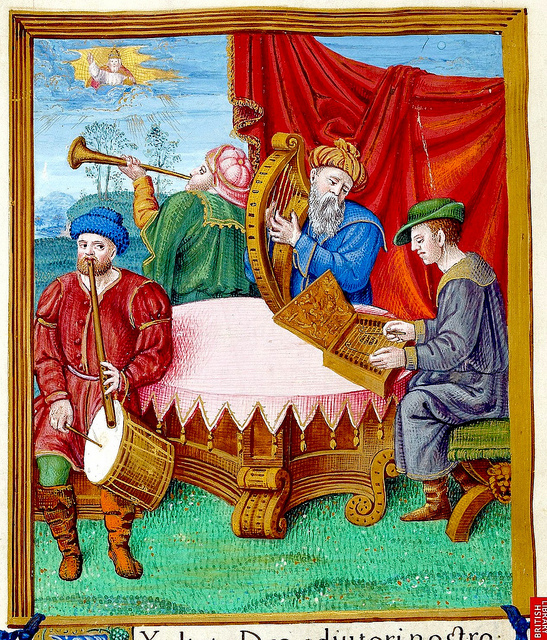
Page from Psalter made for Henry VIII
Venice was one of the independent states that made up sixteenth century Italy. It also had its own overseas possessions, including Crete, and had for centuries been a centre for international trade. The city had a diverse and international population as a result of all this. Although its political influence was beginning to wane, it remained one of the great European centres for all the arts.
The Bassano family had appeared in Venice in the late fifteenth century. The surname they finally took was that of the village in the Veneto where they lived for a while, probably making a living by trading in silk. There is some evidence that the family was of Jewish origin, moving from Sardinia or Portugal when Jews became unwelcome there.
Sometime in the early 1530s the Bassanos were approached by one of Henry VIII’s agents about the possibility of moving to London, and four of the brothers, Alvise, Anthony, Jasper and John, were invited to England to play for the King. They stayed for about a year, playing in one of the bands that were employed at court, on standby to play for Royal guests, but then returning to Venice. But in 1538 all six of the younger generation of the family moved to London, bringing with them their whole stock of instruments, and taking permanent court appointments. The grandfather of the family became known by the surname “Piva”, meaning “bagpipe”. And at some point the Bassanos moved from silk to music, with some success, as they obtained a place at the court of Venice’s ruling doge, where they both played and made musical instruments. The memory of the silk was kept alive by the maker’s mark they chose for the instruments they made: two silk moths.
Sometime in the early 1530s the Bassanos were approached by one of Henry VIII’s agents about the possibility of moving to London, and four of the brothers, Alvise, Anthony, Jasper and John, were invited to England to play for the King. They stayed for about a year, playing in one of the bands that were employed at court, on standby to play for Royal guests, but then returning to Venice. But in 1538 all six of the younger generation of the family moved to London, bringing with them their whole stock of instruments, and taking permanent court appointments.
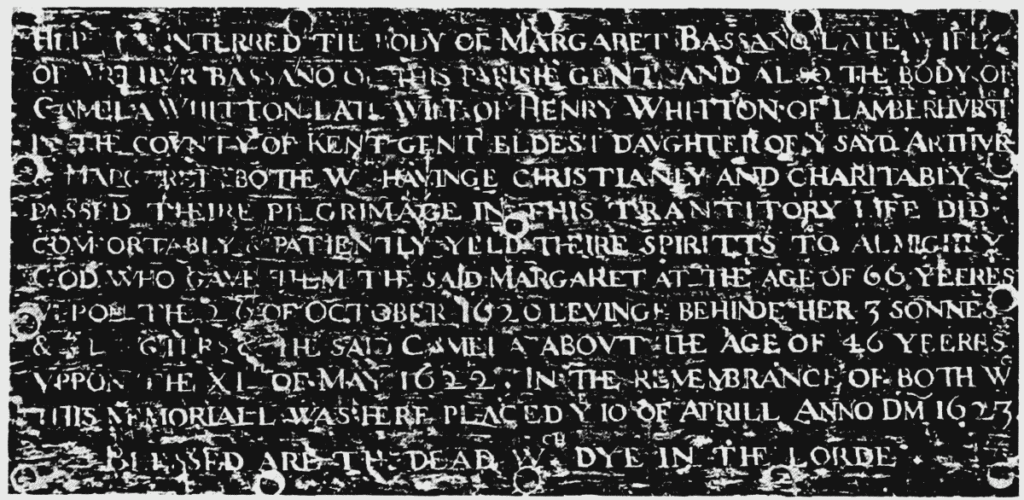
The Bassanos also found premises, first in the former monastic buildings at the Charterhouse, then in Mark Lane near the Tower of London where they set up a musical instrument making business. Like almost all Londoners of their time, they were churchgoers: their names appear on the records of All Hallows by the Tower, where members of several generations of the family were to be buried. A plaque to one of them is still in place.
The Bassano memorial at All Hallows by the Tower
And once they were settled and prosperous enough, the Bassanos began to buy property away from, but within reach of, the City. Walthamstow, with its good communications and rich farmland, was not a surprising choice. The first Bassano house here, on what is now Walthamstow High Street, was called The Starlings – as time went on other members of the family bought houses and property locally. It is likely that, like other City people, they commuted here for peaceful weekends and holidays away from the noise and dirt, and that their children lived here full time.
In early Tudor times most music was played, sung and listened to in private houses and churches. Not only was there no recorded music – there were no public concert halls, and public theatres only began to appear later in the century. For most people, if they wanted music they would play and sing it themselves. Any educated person was expected to be able to sing, dance and, preferably, be competent on one or more musical instruments. This was especially important for anyone hoping to get a job in a grand household (and this was the usual way up in the world). Students going to university or law school were often provided with musical instruments as part of the equipment they took with them.
Musical instruments were prized items, and the Bassanos were clearly skilled and adaptable makers. An inventory of a wooden chest of instruments for sale lists over a dozen different kinds of wind instrument, and there are other references to stringed instruments such as an inlaid ebony lute. The Bassanos, like other makers, signed the instruments they made, in their case with two silk moths. Probably in reference to their silk-dealing past. And these instruments often sold for high prices – Sir William Petre of Ingatestone Hall paid nearly £1 for a lute for his son – this at a time when £5 a year was a decent income.
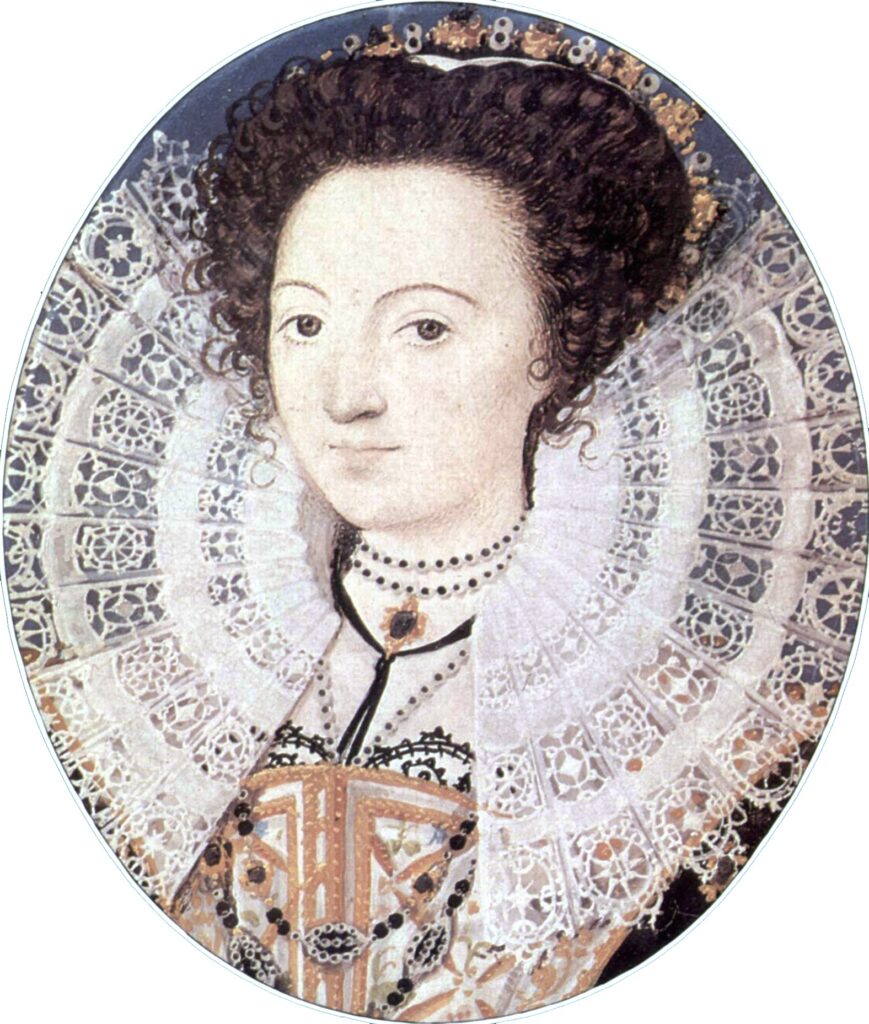
The six brothers all had children of their own; many of them became musicians and instrument makers – there were Bassano musicians at court until at least 1630, and over the intervening years most of the sovereign’s musicians were family members or part of their circle. The name of one of the second generation, Emilia Bassano, later Lanier, has recently become famous as there is evidence she may have been Shakespeare’s Dark Lady of the Sonnets. And it is now claimed that this exquisite miniature by Nicholas Hilliard is of her – certainly the sitter has silk moths, the mark of the Bassanos, embroidered on her bodice.
Emilia Lanier, nee Bassano by Nicholas Hilliard
There were Bassanos in Walthamstow and nearby at Waltham Abbey for at least a hundred years – one of them had to pay extra tax in 1615 instead of helping to maintain local roads. And in London, there were Bassanos living at their house in Mark Lane until at least the 1640s. There were a number of families of Italian descent in the area.
In the nineteenth century the name Bassano again became
famous when Alexander Bassano became a fashionable photographer specialising in
rehearsal shots of theatre productions – this one is from a “Henry VIII” of the
1890s. In the 1960s Bassano and Vandyk
were well known society photographers – and there are Bassano musicians in
London today. As to their instruments,
only a few years ago a Bassano recorder, complete with silk moth logo, was
found for sale in a market – still in a playable state.
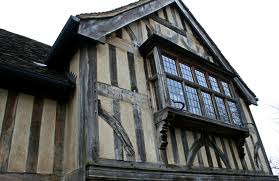
A wing of it, beautifully restored, recently went on the rental market for around £2,000 a month. A hundred years ago it was a row of rather sorry-looking shops. Before the first Tudor became king it was already too small and old-fashioned to be a manor house. In between it has been a farm, an auction room, a bike repair shop and a café. It was saved from collapse and given a new roof in memory of a local builder in the 1930s. It has featured in countless photographs and indifferent paintings. It only became known as The Ancient House of recent years.
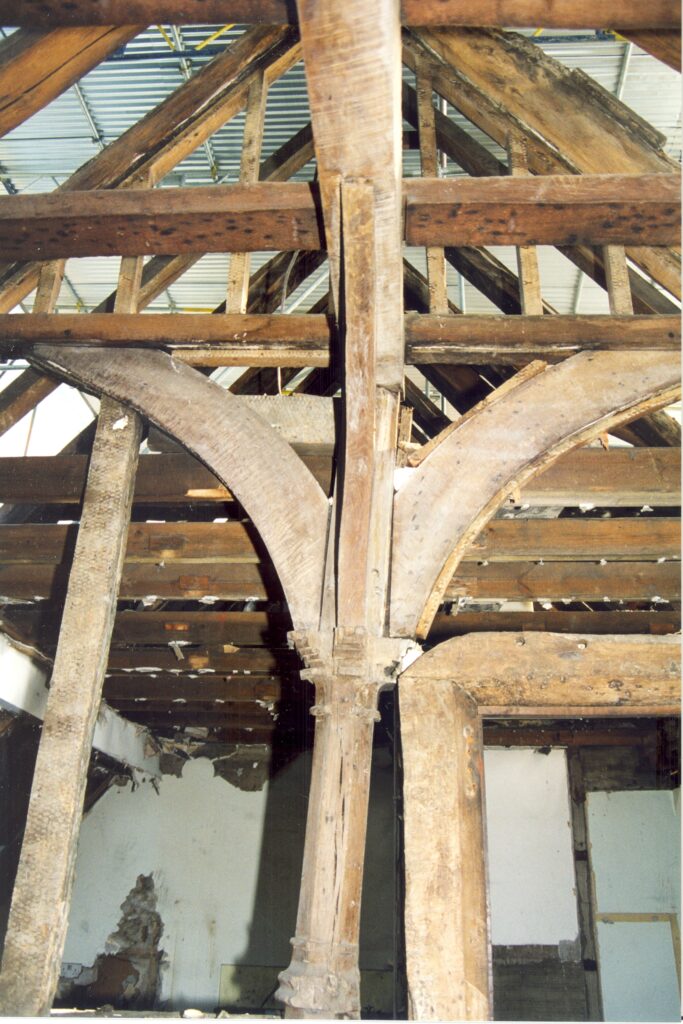
The Ancient House during restoration, with a view of the crown post roof
There has been a house on the site, conveniently situated opposite the equally ancient St Mary’s Church, since perhaps the twelfth century, when Ralph de Toni married Alice, a niece of William the Conqueror. Their descendants were, initially, Lords of the Manor of Walthamstow. As time went on the manor was divided up, initially into two – the high and low halls. But the high hall became known as Walthamstow Toni, and over time several other manors were chipped off the two main ones. And it seems that the first manor house was no longer big enough or up to date enough for the tastes of its late mediaeval occupants. So they built themselves a new home in what was one day to become Shernhall Street (its stables and outhouses were still in place until a few years ago). And it looks as if the old manor house – probably a hall with a fire in the centre – was demolished and replaced with the current one. The beams of its roof were still trees in the 1430s.
That new house appears to have been rented out as a farmhouse, complete with a small parcel of land. It may have belonged initially to the Vicar of Walthamstow, John Hill, who owned several properties locally. From the description, this could have been a property called Kykelwoldys, one of the houses Hill left to various relatives in 1480. The property was a copyhold – a form of leasehold – from the Manor of Walthamstow Tony, and was home to a number of different residents in the next two centuries. By 1757 the building had gone down in the world, becoming two separate dwellings, both owned by one Theophilus Green. Walthamstow was growing, albeit slowly, now with a population of around 3,000. The main commercial area was still around Orford Road – Hoe Street and Marsh Street (the present day High Street) were lined with grand houses, mostly in extensive gardens, for the most part the homes of City merchants who needed easy access to their places of work. They would have scorned the Ancient House as being too small and too old fashioned. It survived because it went on being useful.
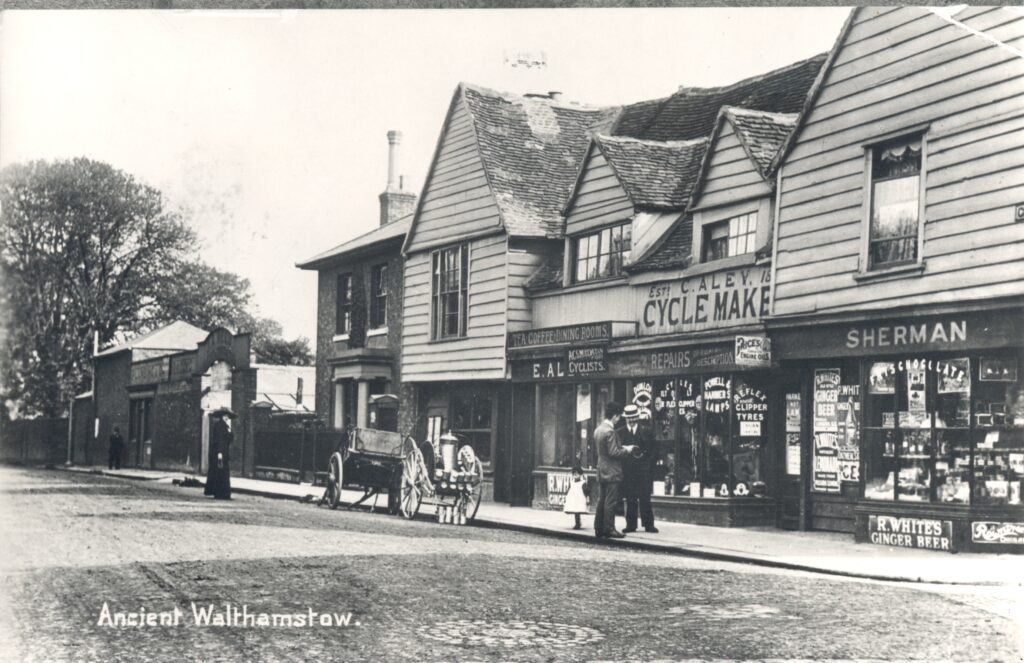
The Ancient House features on an early twentieth century postcard – still in use as several down to earth shops and workshops
Through most of the nineteenth century the building was in use as several small shops, a workshop and, at one time, a smokehouse. It became very run down, and, in the 1890s, narrowly escaped being sold as being “ripe for development”. At that time the commercial centre of Walthamstow was moving with the arrival of the new Hoe Street station (now Walthamstow Central) and development further north and west. Marsh Street became the High Street, the outdoor market arrived, and the grand houses began to be replaced by shops. Yet also at this time Walthamstow, as other places, became aware of its own history. The Antiquarian Society was founded, and some of its members began to write, in the local paper and in their own publications, about the history of the area in terms both of buildings and of people.
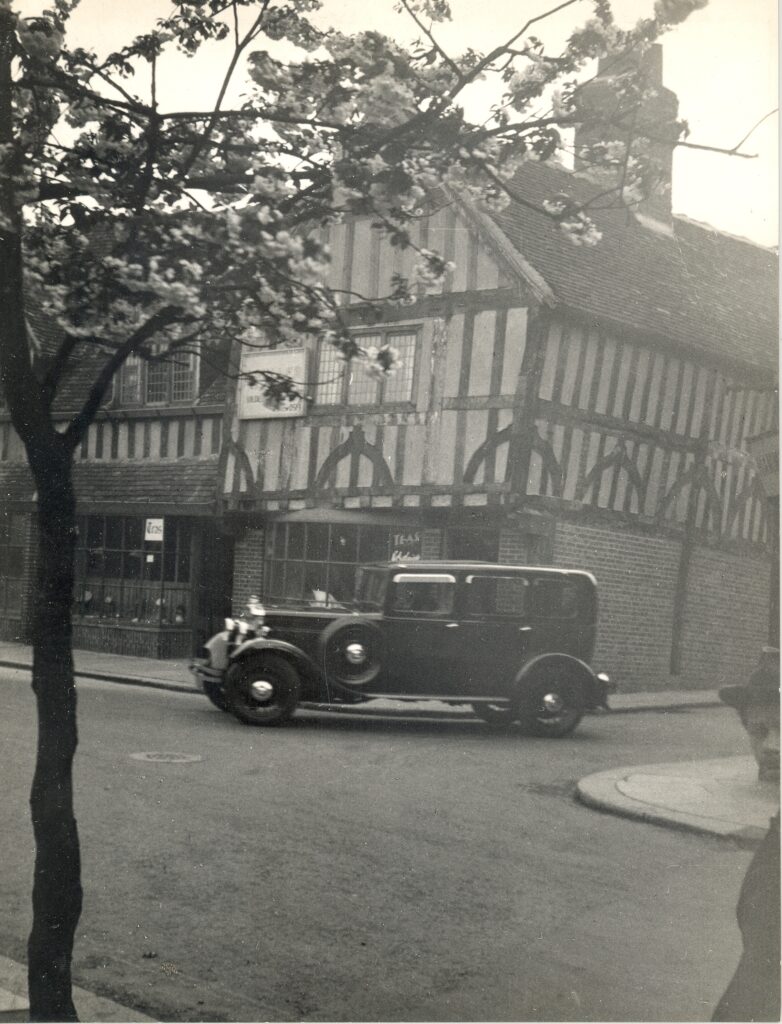
The Ancient House gained its name but continued to go downhill. Early twentieth century pictures show it with a weatherboarded front and a sagging roof. The Fuller family, already established as local builders, bought and restored it in honour of their grandfather. Two thirds of the weatherboarding went, and the building was given what was then regarded as a Tudorbethan appearance. The Fullers continued to let it out as several small shops for some years – by the 1980s these became flats, and in 2000 more structural work was needed, and different choices made in terms of windows and the layout of the courtyard garden. The flats, relatively small, were charming but without central heating. The one in the central range included a hallway open to the roof with a mezzanine bedroom including a large and much needed fireplace. It was worth the effort of carrying coal, as this was the one way of keeping warm on a bitter night. Now it appears that there is central heating – less authentically early modern, but with far less carrying involved.
This romantic image dates from the 1930s, after the restoration – the car almost certainy belonged to the owner of the garage round the corner
There are benefits and drawbacks to living in an icon in what is now termed “the heart of Walthamstow Village”. Residents have to get used to would-be visitors peering through the windows and scrabbling at the doors at all kinds of hours, hoping for a guided tour. But there is always the prospect of coming home to beauty and having an evening drink surrounded by six centuries of history. The tenants of the past century or so would certainly recognise the place, but would probably be bewildered by the curious or envious eyes outside.