The Plague Pit: myth, memory or tall tale?

Plenty of  stories out there to choose from, of course – from the Romans leaving the country in two straight, orderly lines in 410, to the dream of crime and conflict free unity in the Blitz.  And a rich selection of people glossed over with layers of storytelling, from the Princes in the Tower to Jack the Ripper.     The same turns out to go for local history.  Some themes are everywhere:  underground tunnels.  Lost Roman villas.   Visiting monarchs, Elizabeth I or Charles II for preference.  And plague pits. 

Specifically, at this precise moment, a plague pit claimed to be in Walthamstow.  On the face of it, nothing too unlikely about that.  St Mary’s, Walthamstow has been a parish church for nearly a thousand years, although little remains of the building that was created in the time of Ralph de Toni, standard bearer of William the Conqueror, in around 1108.  In the centuries since, the church has been added to, upgraded, knocked about in wars, locked up, opened up and repeatedly reimagined – it emerged from the Second World War shorn of most of its south aisle.  However, it is surrounded by what is now sometimes referred  to as “the church campus” – a graveyard as old as the parish, with a former school building dating from 1828, the site of the original vicarage, many times rebuilt, and the almshouses first endowed by Sir George Monoux, the Tudor merchant and Lord Mayor of London who settled locally and who also founded a school and funded extensive rebuilding of the church where his memorial still survives.
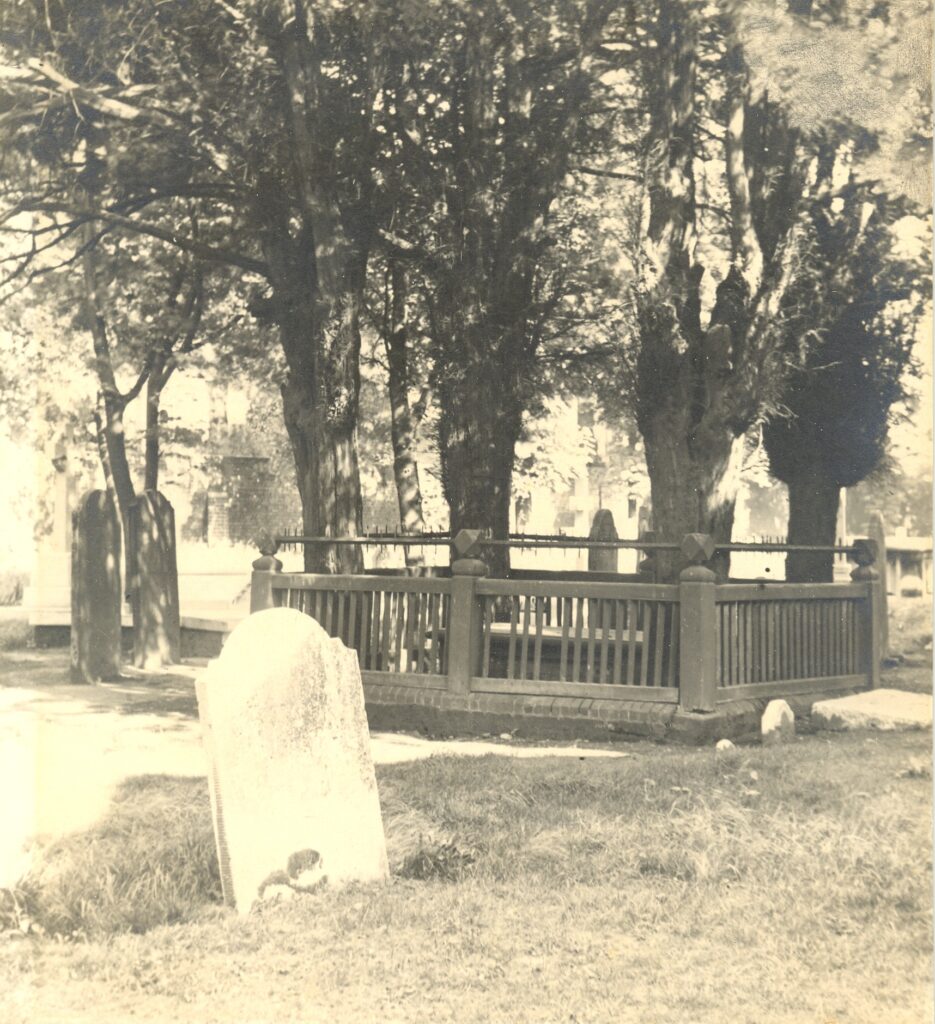
St Mary’s Churchyard, image courtesy of Vestry House Museum

The street layout around St Mary’s remains, give or take a few recent incursions by the local authority, much as it has been for several centuries, although many of the names have changed.  Orford Road, for example, has skirted what used to be the common land for at least four hundred years, but only acquired its present name in the eighteenth century.  And the iconic Ancient House, star of so many photographs and watercolours, itself fifteenth century and the site of an earlier manor house, passed several centuries covered in utilitarian weatherboarding and serving as several shops and a café.   The romantic name started to be used after the building was saved from collapse and restored by a local builder. 
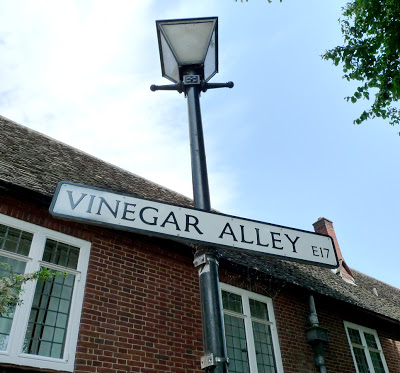
Another name, less romantic, has a story attached:  Vinegar Alley runs along the periphery of the churchyard.  Over recent years several claims have appeared on websites that this is because the lane runs alongside a burial site associated with the Great Plague.  Some of the sites go on to describe dead bodies being brought in carts from London to Walthamstow in 1665, and the name Vinegar Abbey deriving from attempts to disinfect the area with vinegar.  A graphic and memorable story.    

The 1665 plague killed at least 68,000 Londoners, a figure that may well be an underestimate.  Serious attempts were made to contain the infection, with houses being placed in quarantine if one inhabitant become ill.  The dead were collected at night;  bodies were loaded onto carts and, as the epidemic continued, buried with little ceremony in pits on the outskirts of the city.  Multiple burials have been located, and sometimes excavated, at Aldgate, Houndsditch and Bishopsgate, among many others.  Attempts were evidently made to bury the dead in, or close to, consecrated ground, although this became difficult as the outbreak spread.   Daniel Defoe was five years old at the time of the Great Plague.  His “Journal of the Plague Year” is a work of imagination, yet he was a Londoner with relatives who survived the epidemic.  Some of the records were destroyed in the Great Fire of the following year, but the burial grounds were there for all to see, including the Great Pit described in the book as being located at the edge of the graveyard of St Botolph without Aldgate.   When Aldgate Station was created in the 1870s, human remains were discovered, although it remains unclear whether the bones were those of Plague victims.   All the evidence, however, is that London plague victims were buried as close as possible to where they died.
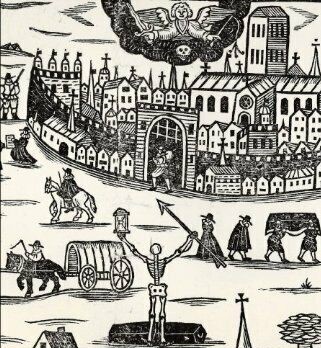
Woodcut from a 1665 newsletter

In 1665, as in other plague years – about one summer in ten claimed a significant number of victims – towns outside London did their best to avoid infection.  However little was known of the exact way the disease was carried, no one was in doubt that it was dangerous to come into contact with a sufferer or their possessions.  Elizabeth I had taken refuge from the plague at Windsor one hot summer, and decrees forbade anyone travelling from London to Windsor;  transgressors were hanged without trial.   And, famously, at Eyam in Derbyshire in 1665, the community agreed to isolate themselves to protect others once the infection arrived in their midst in a parcel of patterns sent from London. 

Between those extremes, people did their best.  Walthamstow was a small place, a series of hamlets connected by lanes.  In the Tudor period only around 100 people lived there;  most worked on the land – there were rich meadows, hop fields and at least one mill.  By 1679, a few years after the plague, there were 189 buildings, so it is realistic to imagine a population of perhaps 500.  We do not know with certainty whether the plague reached there in 1665 – there is a story that local people stood guard at the ferry so as to deny entry to London refugees, but there would of course have been nothing to stop the determined and the desperate from making their way across the marshes.  It is true that vinegar was used for disinfecting purposes at this time, and the claim is that quantities of it were used to ward off infection from the corpses thrown into a nearby mass burial site.  Sadly for that theory, the name Vinegar Alley appears to date only from the late eighteenth century.  At that time Beulah Road and the surrounding area were home to the main industrial and commercial premises for Walthamstow, and these included a leatherworker whose trade would certainly have included the use of much vinegar. 

There is also a claim that errant plague pit was actually some distance away, and was disturbed at the time of the creation of the Chingford Line in 1870.  The land to make the line was part of the Berryfields, some of which was inclosed and sold to the railway company by the Vestry (the predecessor to the Council).  It was indeed common at this time for work on the new railway lines to unearth burials;  the remains were routinely reinterred.  There does not, however, appear to be any evidence for this.  There is a blue plaque on the former Sorting Office recording that the playground opposite was once part of the Berryfields.  But nothing about bones. 

It is of course impossible to be sure.  Some myths and legends have their roots in historical fact.  Only a couple of years ago archaeologists uncovered the remains of a Roman settlement only metres from St Mary’s church: no one appears to have known.  And sometimes the unfeasibly unlikely happens:  Richard III’s remains being dug up intact in a Leicester carpark would be unbelievable if it had not happened.  Far less likely than a plague pit in an old churchyard.   
Permanent link to this article: http://lissachapman.co.uk/walthamstow/the-plague-pit-myth-memory-or-tall-tale/

Desperation or Liberty? Life in Lea Bridge Gardens

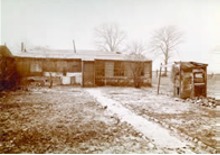
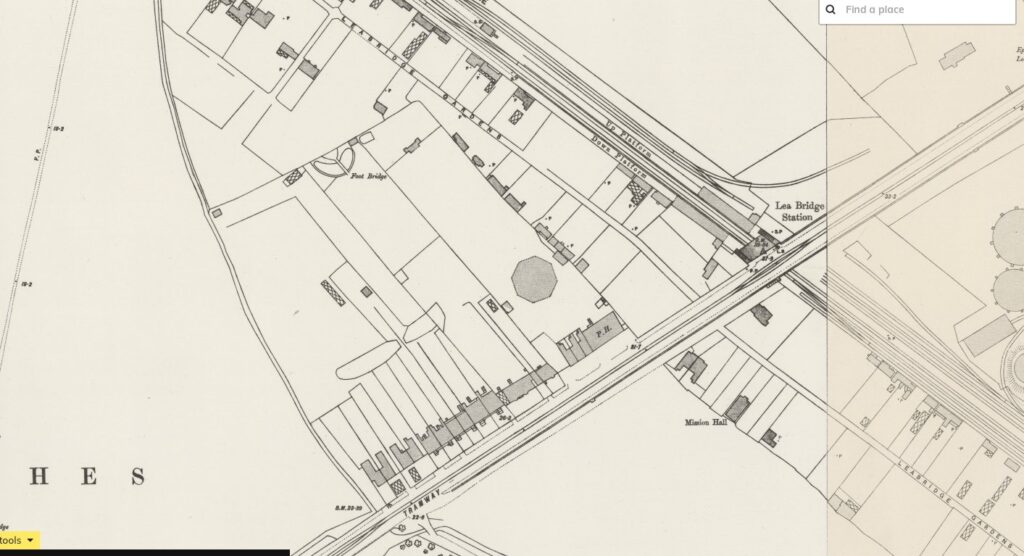
It vanished piecemeal nearly a hundred years ago.  The “dwellings” were considered a health hazard by the 1930s.   But before the days of building controls, a haphazard development of up to a hundred homes had grown up – Lea Bridge Gardens.  Or the Bungalow Town.   These were the unofficial homes of the poor.

And because it was all very unofficial there are few surviving records of who came here first, probably not long after Lea Bridge Station opened in 1840, bringing with it some of the earliest housing for commuters in the area.  It also brought a direct route from the terminus at the new Shoreditch – later renamed Bishopsgate – Station. For many years this had been an area where newly arrived Londoners settled, often moving on either when they became prosperous or when their attempt at a new life failed.  In the 1850s and 60s the silk industry in the area, and many of its workers, often immigrants, moved away to seek new employment.  One suggestion is that some of them became the first residents of Lea Bridge Gardens, some of them finding work in the textile, and in particular fabric and yarn dyeing, trade in the area. 

Lea Bridge Gardens in 1893

Whatever made the new residents choose that particular spot, the first houses were of the most basic variety.  The Rev’d Morgan Gilbert, then a young curate from Leyton became a regular visitor in the 1880s, and remembered dwellings built round living trees, incorporating the roots and branches as storage for possessions, roofs made of whatever came to hand and trodden earth floors. Morgan certainly believed that the first residents were Spitalfields weavers who “had been  driven out of their East End refuges”.  Fresh water was available from wells, but the only sanitation was earth closets.  There was no heating and none of the dwellings had a proper kitchen. In later years a custom built wooden mission church and school room were set up.  But the road was still a dirt one, reached by going under an archway which, for many years, was the only shelter of an elderly hawker and his donkey.

One of the cottages – and its outside earth closet – in c1910

Each dwelling was built of a plot big enough to provide a long garden, and some of the residents made a living by raising vegetables and flowers;  some also kept hens and sold surplus eggs.  On summer Sundays the children took baskets of flowers up to the Lea Bridge Road and sold them to day trippers on their way to Epping Forest.   Morgan remembered children “holding out small bunches and buttonholes, running along by the carts and vehicles of any description, begging for pence in return for a lovely bunch of sweet scented buttonholes or sprays for the ladies”.  He remembered, too, that the parish rented one of the cottages as a mission room in those early years, and that they paid for teacher and for books so that the children had at least a basic education.

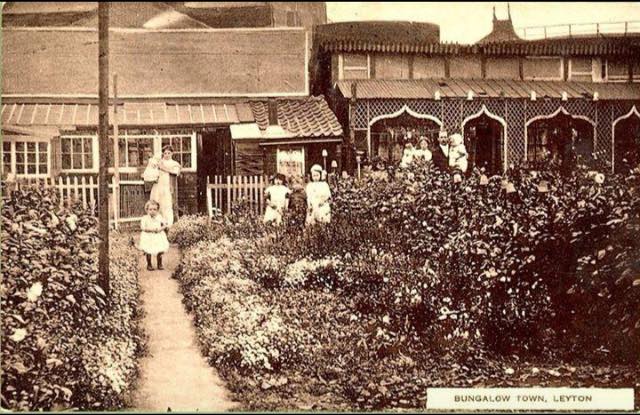
By the end of the nineteenth century Lea Bridge Gardens was an established community;  a photograph shows neat-looking bungalows and well tended gardens.  The residents seem to have been a mixed group, still including market gardeners, but also people of a variety of occupations, including a musician, a printer or two and, for a few years, a retired ivory carver from Houndsditch, Richard Kingsman, who had fallen on hard times and had to move in with his son, came into a legacy and so was able to buy a bungalow and, in his eighties, live independently for his last few years.   Another suggestion about those years is that tradesmen from Hoxton bought up some of the plots to provide a summer weekend retreat for their families.  At least some of the residents were there because that was where they wanted to be and that was how they wanted to live.

One of the cottages, its gardens and its residents looking well settled in c1910

But times changed, and brought with them building controls, medical officer of health reports highlighting the rates of infectious diseases and higher standards of sanitation.  In the years after the First World War and, after it, the horrors of Spanish Flu, the authorities began to take an interest in Lea Bridge Gardens.  Rather than any draconian attempt at mass eviction, as each bungalow became vacant it was closed down and demolished.  By the early 1930s all had vanished, and today no visible trace remains. 

Permanent link to this article: http://lissachapman.co.uk/walthamstow/desperation-or-liberty-life-in-lea-bridge-gardens/

The quietest millionaire?

“A respected benefactress” – the bonneted  shade of Miss Elizabeth Cass might be forgiven a wry smile at our expense.  She and her equally well regarded sister Phebe have given posterity the slip, and got clean away, thanked, and unchallenged, although their weed-choked memorial would hardly please them.

Elizabeth Cass lived in one of Walthamstow’s grandest houses at a time when this was still a small country town, and when Orford Road was still known as Church Common Road .  Orford House is still standing, although its elegant white frontage is so far back from Orford Road that many people walk past without realising it is there.  A stuccoed two storey, gracious “gentleman’s residence”, the third house on the site, it was built in around 1801 – and it seems lost without its surroundings of gardens, stables, meadowland and ornamental pond.  This was a neighbourhood popular with merchants and bankers who had made a fortune in the City and wanted space, healthy air and a desirable residence in its own grounds, all within easy reach of their places of work.  Hoe Street, Marsh Street (now the High Street) and the area round St Mary’s church were fringed with substantial houses. 

Orford house – the central range, still much as it was in Elizabeth Cass’s time

Externally, Orford House remains much as it was when Elizabeth and Phebe Cass lived there.  Socially they must have settled well into the neighbourhood, differing from their affluent neighbours only in that these were two single women running their own lives.  Internally one of the few features remaining from their time is the elegant cantilevered staircase.  This was a house that took several servants to maintain:  some, including a long-serving housekeeper, are remembered in the will of Elizabeth Cass.  We know, too, that the many rooms were expensively fitted out with  luxury items such as silver tea sets, jugs and candlesticks, as well as gilt looking glasses and opulent furnishings.  This was only a small part of the property owned by the Cass sisters, who lived in Orford House only in the last years of their lives.  There were several other freehold and leasehold houses in Walthamstow, some but not all inherited from their father.    These women were not merely prosperous, but rich.  Orford House in their day was smaller, without its eastern extension.  It would, however, have provided a generous home for two ladies and their servants.  We know that both sisters were devout, with Bibles and prayer books precious enough to be left as bequests, as are items of embroidery equipment and some of the work they produced.

Their parents, John and Phebe Cass, had moved to Walthamstow from Whitechapel where they retained business links and a house.  This John Cass was descended from a cousin of “the” Sir John Cass who left his fortune to maintain the school for poor London children he and his wife had founded.  Famously, Cass died suddenly in 1718, before he could sign every page of his newly redrafted will, and it took thirty years to settle the legal case that dragged on between the those who wanted to see his wishes carried out and the “heirs at law” – relatives who wanted his fortune for themselves.    Interestingly, though, there is evidence that the network of cousins evidently stayed in touch and took an interest and pride in the Cass school.  This went on being the case for many years – however, the court case dragged on well into the lifetime of the John Cass who moved into Walthamstow and who was born in 1732, and the case was not resolved until 1748.   It becomes less surprising, then, that his daughter Elizabeth left some of her fortune to Sir John Cass’s school, and to the other charities he had favoured. 

Sir John Cass had been an only child, son of Thomas Cass who had made a fortune from the rebuilding of London in the aftermath of the 1666 fire.  He was  himself the son of an innkeeper, yet another John Cass, possibly of French descent.  Sir John Cass was a highly successful City businessman and politician.  He was an MP, alderman, liveryman of both the Carpenters and then the more prestigious Skinners Company.  He was also one of the many City businessmen of his day who invested in the Royal African Company, whose main activity was slave trading – more than that, he served on the ruling Court of the company in an attempt to bring them back into profit after Bristol had become the British hub of the slave trade.  Ironically, although Cass held £5,000-worth of stock in the Royal African Company, it appears that the dividends he received over a period of years added up to less than £200, a drop in the ocean in terms of a fortune that ran into millions.  This is not to obscure the fact that Cass, and his City colleagues, would have been more than happy to take any money from slavery that was on offer.  The reality, however, is that the money that went to set up the Cass Foundation was overwhelmingly derived from building and rents. 

Two generations on, the Cass cousins who had failed to hijack the fortune of Sir John Cass, and their descendants, had not been idle, and were certainly a part of the City of London.  A Mary Cass was a glover (at this time women could trade in their own right);  a John Cass of the next generation, perhaps her son, was her apprentice, and later became a haberdasher.    Clearly the  money-making gene was a dominant one in the Cass family.  The John Cass who moved to  Walthamstow was a wealthy man who left his daughters a fortune in property and stocks and shares.  He evidently also left them the confidence and knowledge to operate in the business world for themselves:  there are records of a number of court cases in which Phebe and Elizabeth Cass took action over matters relating to their property portfolio.   The family retained their house in Whitechapel – Elizabeth paid the insurance for it in her final year – and it seems likely that they continued to think of this as their main home. 

When Elizabeth Cass made her will she was able to make bequests to over  a dozen charities.  Most of these were for £3,000 or £4,000 (multiply by at least 200 for a present-day value) , and this does not take into account the value of her freehold properties or the contents of her house.  In Walthamstow there are bequests of £500 to a local school, and £4,000 to be invested and the income used for the local poor, stipulating beneficiaries should be of good character and should be members of the Church of England.  A small sum was to be put aside each year for the maintenance of the Cass family grave, and £30 earmarked to be given annually to the vicar and churchwardens for their trouble in administering the bequest.  However, the bulk of the legacies were made to London charities, including not only those favoured by Sir John Cass but a number of others including a home for female orphans.   Elizabeth also left annuities, mostly of £50 a year (an adequate but not generous income), to several cousins and former servants, with careful instructions that the money should be paid only to the intended recipient and no one else:  not unusual at this time when it was not unknown for attempts to be made to “sell on” the right to an annuity. 

The Cass memorial in the graveyard of St Mary’s, Walthamstow

All the instructions appear to have been honestly carried out for nearly two centuries.  Elizabeth shares the grave of her parents and sister as she wished.  The inscription, almost certainly chosen by her executors, records her as “a liberal benefactress to many charitable institutions, but especially to the parochial schools and the poor of this parish”.  They credit her with having lived a “truly Christian life and died in hope of a better world”.  It is a sadness, though, to record that Elizabeth Cass’s Walthamstow charity was dissolved as recently as 2017, and, looking at the present state of the Cass family memorial in the churchyard of St Mary’s Walthamstow  it looks as if it has suffered from several years of neglect.  Ivy has grown over it, and the only inscription that is currently decipherable is that of Elizabeth’s sister Phebe.  Organised as well as kindly people, they would certainly resent it.

The inscription commemorating Phebe Cass – the only part of the tomb currently visible

Permanent link to this article: http://lissachapman.co.uk/walthamstow/the-quietest-millionaire/

Annie West: The Saddest Christmas Shadow

Annie West only lived to be ten.  Her unmarked grave, shared with eleven others including five babies, is in Queen’s Road Cemetery, Walthamstow;  the plot was resold many years agoIn the final decades of the nineteenth century, when Annie lived and died, it was all too common for families to lose a child, sometimes several.  In those days before antibiotics, not only TB but any winter cough could be a killer, and a “delicate” child was often “not long for this world”.

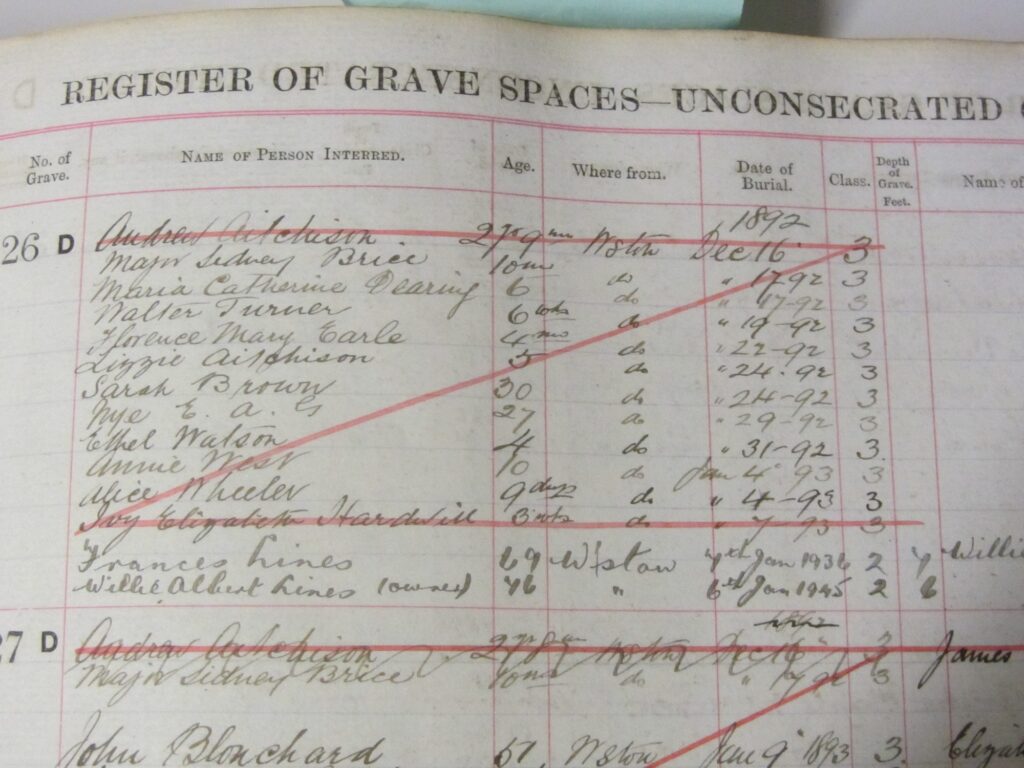
Annie West’s burial appears on this page. The plot was resold in 1936

But Annie was fit and well, the eldest of six children of Richard West, a respectable working man with a steady job as a stoker at the local gas works and his wife Sarah.  Then she ran out of her home on Boxing Day 1892.  Her frozen body was found beside a ditch less than half a mile away the next day.  And her inquest, held over two weeks in January 1893, attracted national publicity, local gossip, the attentions of the newly formed National Society for the Prevention of Cruelty to Children, a false confession of murder – and public vilification of Sarah West, who was blamed as being “morally if not legally” responsible for her daughter’s death. 

The known facts are these.  Annie left the house in a hurry on the evening of Boxing Day, without a coat, hat or warm shoes.  Her mother claimed that she had believed Annie had only gone outside for some coal for the fire.    But Annie spent the next few hours walking the local streets, telling her friend Ada Lebern, whom she met by chance, that she did not want to go home.  Ada gave Annie an orange to try to cheer her up.  It was found still in her pocket after she died.  Annie talked about sleeping in the dog’s kennel at home, but after she and Ada parted company she set off in the opposite direction in the bitter weather, towards Low Hall Farm, and it was there, beside a ditch, that her frozen body was found the next day.

About three in the afternoon of 27th December a passer-by at Low Hall Farm saw a group of boys “looking at something in the ditch” – going to investigate, he discovered Annie’s body, kneeling face downwards in the ditch, with an orange in her apron pocket.  A policeman was called and took the body to the mortuary at Queen’s Road, where it was examined by a local doctor, who noted that the corpse was so frozen he had difficulty in making his examination.  The policeman was to say at the inquest that there was no sign of a struggle at the spot;  the doctor was clear that there was no water in Annie’s lungs;  he was sure she had frozen to death in the temperature of the previous night.

Annie’s funeral took place on 4th January – perhaps at St Saviour’s Church in Markhouse Road where she had been christened nine years before.  The burial was in a shared grave where there were to be eleven other burials in all, including five babies.  This was the common practise of the time, and the fact that the burials were in unconsecrated ground reflects simply that this was in the part of the cemetery that was opened to Nonconformist as well as Anglican burials.  The register entry tells us, too, that the plot was resold some forty years later, in the 1930s.  This, too, was routinely done with “common” graves.


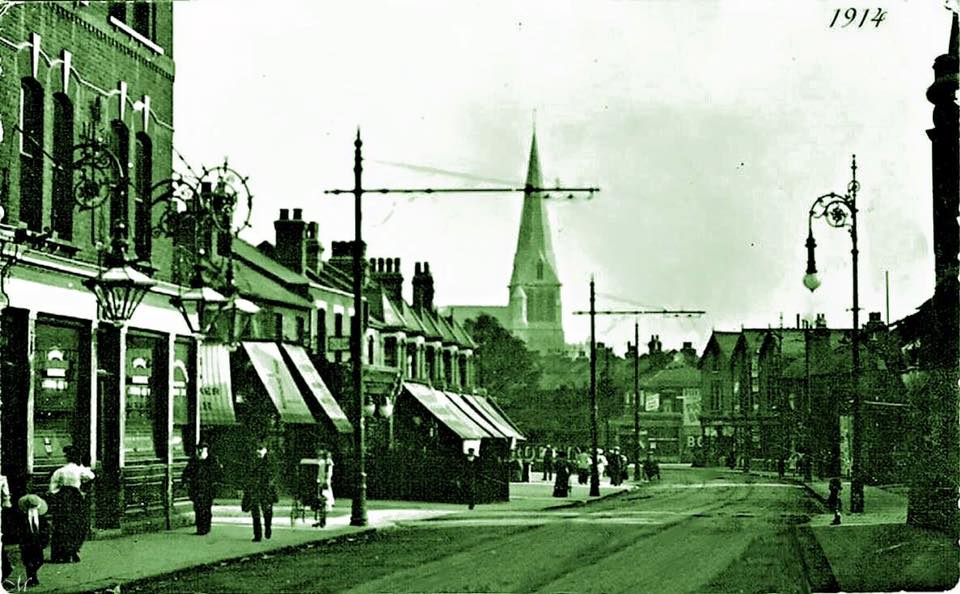
Markhouse Road with St Saviour’s Church in 1914

All this was before the media circus got going.  All inquests were fully reported in the local press, with the statements of witnesses and the coroner being printed verbatim.  This one did the 1890s equivalent of going viral as the circumstances became known.  At an early stage the Coroner stated that “some man had given himself up to the police, and alleged that he had caused the death of the child….. he had only been discharged from a lunatic asylum on the previous Sunday…a man who had given himself up for various offences”.  However unfounded in fact, this was, however, a promising piece of fuel to feed the media frenzy.  Only four years after the last of the so-called “Jack the Ripper” killings, whose coverage had sold many newspapers, a new murder did wonders for a paper’s circulation.   Depressingly, at least one recent writer has suggested that this unfortunate man drowned Annie, despite the fact that she was not drowned and he was nowhere near at the time of her death. 

And in the absence of a murderer,  Sarah West was vilified.  The standards of her day required a pregnant mother of six children under ten to be “grateful”, as one juror put it, that her husband “entrusted” money to her to feed the family, and him.  No matter that Richard West habitually came home from work only to barricade himself in the quietest room to sleep until his next shift.  He had worked through Christmas night, slept through Boxing Day, waking at five in the afternoon to discover the children had not had their dinner, which was spoiling in the oven.  In the course of the inquest it emerged that Annie had run away from home on four previous occasions, and the police had brought her back.  Nothing had been done to support the obviously struggling family.  Neighbours had known all was not well;  one claimed that Sarah was often drunk, and would quarrel with Annie, turning her out of the house.  The Coroner claimed “Mrs West’s conduct is most reprehensible”, and after the verdict of death as a result of exposure had been returned, he proceeded to abuse her in Court.  

The case had been reported nationally, and must have been the talk of Walthamstow as well as filling many column inches in the “Walthamstow and Leyton Guardian” for three consecutive weeks.  It is hard to imagine how the West family dealt with their notoriety.  They did indeed move house, but only about half a mile to Cambridge Road,  a turning off Boundary Road, long demolished.  The press coverage died down, leaving a flotsam of sentimental poetry and an outraged letter or two;  if any report was made by the NSPCC inspector who had apparently attended the whole inquest then it has vanished, as there is nothing on file. 

It seems, then, that for the West family life returned to some kind of “normal”.  They had two more children after Annie’s death.  In 1911 Sarah West listed that she had had a total of eight children, of whom five were alive.  At the time of the 1911 census Richard and Sarah were living in Netley Road, with only one of their surviving children.  Another, Amy, was living with her uncle Edmund in Leytonstone – evidently the West family was on sufficiently good terms for this arrangement.

Of Annie’s surviving brothers and sisters, we know that Edmund, who had shared her christening, joined the Essex Regiment during the First World War, and was killed in action on 4th January 1918, leaving a widow.  The youngest sister, Alice, had been born in 1897, five years after Annie’s death.  Alice apparently went through life unaware that Annie had ever lived.   Given that some at least of her older brothers and sisters would certainly have remembered Annie, the West household must have been one of gaping silences, perhaps especially at Christmas.

Permanent link to this article: http://lissachapman.co.uk/walthamstow/annie-west-the-saddest-christmas-shadow/

About a Girl: Rachel Harriet Gravestock

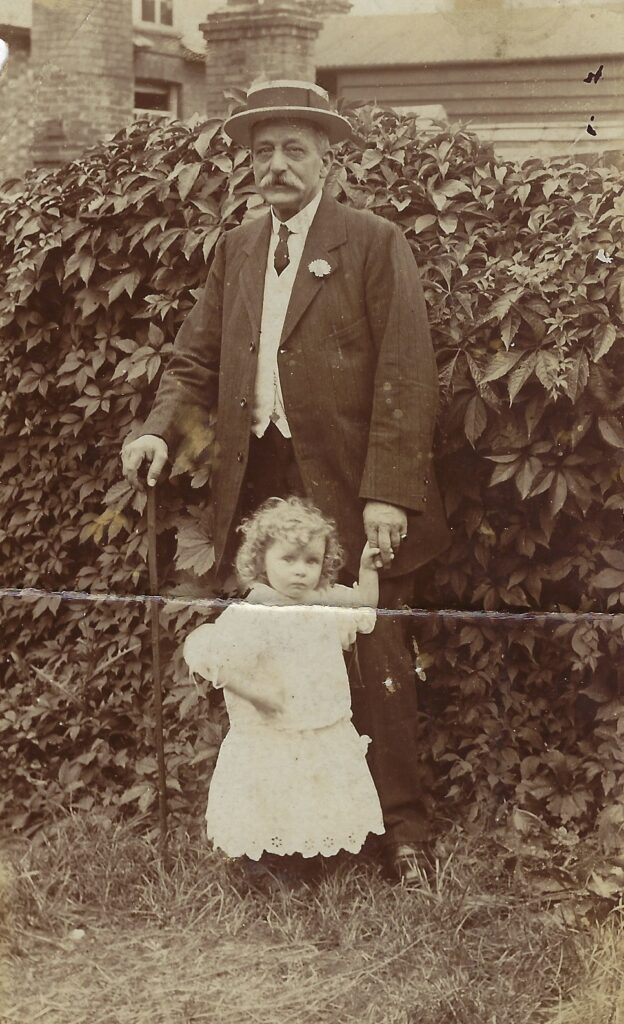
The face under the boater would look more at home in some shadowy corner of the Escorial Palace than in that slightly unkempt garden in Edwardian Berkhamsted, so perhaps the legend is true after all.  My mother had a store of stories about her ancestors, some more likely than others, but this was the one she returned to most.

Pregnant housemaids were an all too common fact of Victorian life.  Rachel Harriet Gravestock was far from being the only one.  She was born in 1834, daughter of James, a gardener, and Rachel Rebecca, a straw plaiter.  At  the time of his daughter’s birth James worked for the Rector of Berkhamsted, The Rev John Crofts, denounced as a vandal for demolishing the Old Rectory and the equally ancient walnut tree in its garden.  James was descended from a numerous family of paupers who had come to Berkhamsted in the 1790s, been hastily baptised and found parish apprenticeships.  He did relatively well in life, becoming a skilled gardener, moving jobs only once in fifty years, when he moved a few hundred years up the high street to become head gardener at the Red House.

Rachel Harriet was born into a world which offered few opportunities to daughters of poor families – it was to be nearly another half century before all children went to school, and even then, for many it merely put off unskilled labour for a few years.  The railway age had begun – work was just starting on the line that was one day to help transform Berkhamsted into a glossily prosperous commuter town – and the canal age had boosted the local economy as it had others.  But for a gardener’s daughter in the 1830s the choices were essentially domestic service or straw plaiting.  And the 1841 census lists her, aged seven, living with her grandmother and aunt and already working as a straw plaiter as they did.  It was to be some years before any other children of the marriage are listed, but by 1851 there were three little girls at home.  

Rachel Harriet was not with them.  Like many others before and since, she was working in London, now much more easily accessible, growing hugely  and offering immense numbers of jobs for servants – especially young ones who could be paid low wages.  By these early Victorian  years it had become de rigueur for any middle class London household to employ at least one servant, generally a teenager, who would usually be expected to undertake all the housework, most of the cooking, work six and a half days a week and all for perhaps twenty pounds a year.   There were, however, many jobs available, and there was an understood hierarchy in terms of how desirable a “place”  might be, with those requiring a sole general servant in a small house in a less-than-grand area at the bottom of the pile.  And that is where Rachel Harriet found herself:  working for a railway overlooker (supervisor), his wife, nephew and lodger in one of the new streets north of St Pancras station.  Perhaps the family was kind and she was happy there, but the work must certainly have been hard and the pay almost certainly low.

We do not know in what circumstances Rachel Harriet’s London adventure came to an end.  But we do know that in 1856, at the age of twenty-two,  she gave birth, in Berkhamsted, to a son, Harry.  All that is officially known of the circumstances is the bleak “father unknown” that appears on his birth certificate.   James and Rachel Rebecca took the child, only a couple of years younger than their own only son, to bring up as their own, believing his grandparents were his parents and his mother, his sister.  Family legend credited him with a Spanish sea captain for a father, and it is true that one of his descendants inherited a ring which has proved to be of Spanish origin.  And it would explain his son’s face.  And his grandson’s.  

Rachel Harriet herself was not thrown out to starve.  1861 found her working as a housemaid for her father’s employers, the Robinson family, at the Red House, Berkhamsted.  This job was many steps more desirable than the one at St Pancras, as Rachel Harriet was now one of seven indoor servants, and her employer a respected iron master.   Ten years later still, in 1871, she was employed as a cook – the top of the service tree – by the Harmer family in Chesham. 

The next year, Rachel Harriet married a Chesham brush maker named Moulder, and went on to have four children with him.  Harry remained with his grandparents in Berkhamsted, became a prosperous printer, married a farmer’s daughter, Rosina Lismer, and had four daughters and two sons.  We do not know what he was finally told about his parentage, but when his son, Ernest, asked him for the truth Harry flew into a towering rage and cut Ernest out of his will.

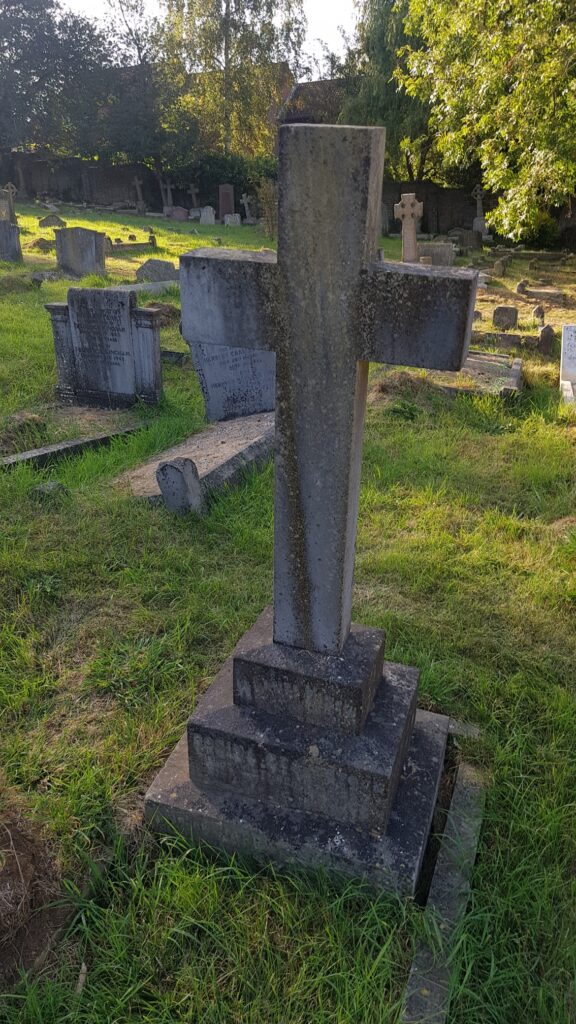
Harry, Rosina and Rosina’s sister Annie Lothian are buried in the cemetery at Three Close Lane – their memorial is near the main path.

Words and images are copyright of Lissa Chapman and may not be reproduced or edited without permission. 

Permanent link to this article: http://lissachapman.co.uk/uncategorized/rachel-harriet-gravestock/

“Born deaf and dumb”

In most ways the Stutter family of Walthamstow were as ordinary-seeming as the thousands of others who had moved into the newly completed housing in the Queen’s Road area.  A decent three-bedroom house with a good garden, a range and a scullery could be rented for around 2s 6d a week, with easy access to the station.  But one thing stands out in their 1901 census return: the eldest son of the family is listed as “deaf and dumb”.  In all other respects this was a very typical family, who had moved to Walthamstow from Bethnal Green.  The father of the family, a silk spinner called William Stutter, had been working as a tassel maker in his teens, living with his widowed mother Jane, a laundress.  He had married – he and his wife Sarah had three daughters and two sons

In 1901 the census did not record very much information:  in each household the name, age, marital status and occupation of every resident is listed, along with any relationship to the “head” –  endless lists of clerks, shop keepers, their wives and children.  But there is one more column on the page – the one which records disabilities.  The possibilities are printed on the form – deaf and dumb, blind, lunatic or imbecile.  The Victorian language seems brutal today, but was regarded as merely descriptive at the time.  In the early days of compulsory education it was far from clear whether the new board schools should provide for children with disabilities. 

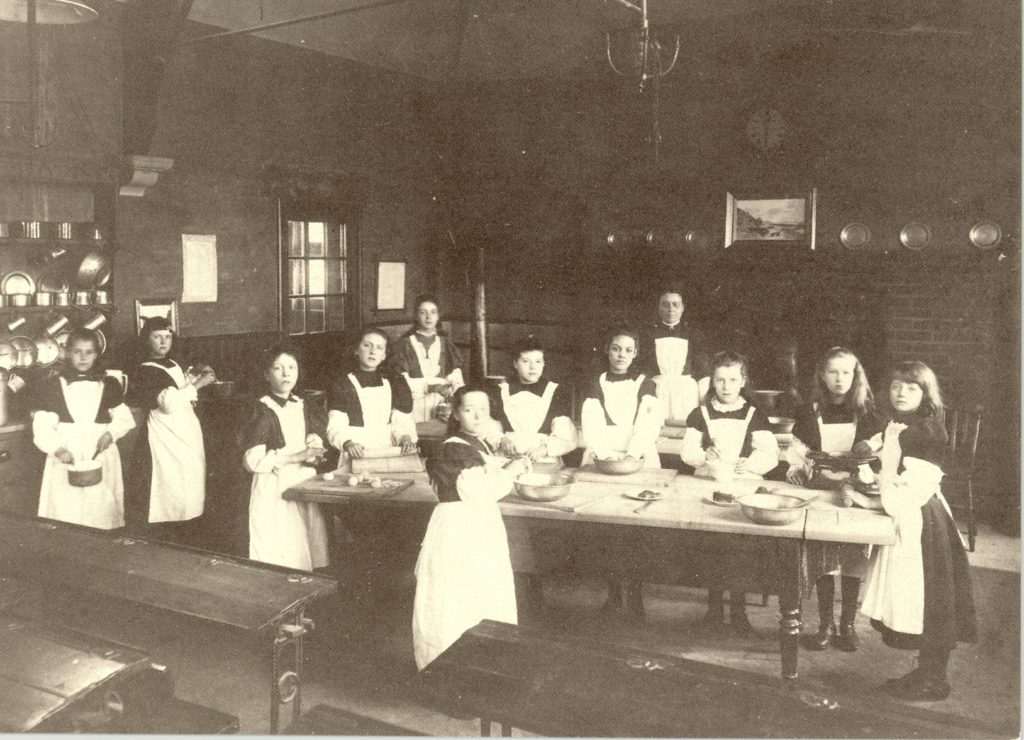
Queen’s Road School Cookery Centre in c1905

We know a little of the younger William Stutter’s story.  His family had come to live just round the corner from Walthamstow’s first-ever specialist deaf teaching unit, itself part of the newly opened Queen’s Road school, a custom built showplace incorporating provision for over 1,400 girls, boys and infants, with dedicated classrooms for cookery and laundry.  The new Education Act required local authorities to provide specialist teaching for children with what would now be termed special needs, and the Walthamstow School Board took steps to find out how many children in the area needed specialist teaching.  One of the results was the unit at Queen’s Road, which opened with sixteen children, girls and boys of assorted ages – and one of them was William Stutter.

Specialist teaching for the deaf was not new:  there had been a school in Yorkshire by the 1760s, set up for the deaf children of prosperous families and teaching finger signing alongside reading and writing.  Other, church-funded schools followed, intended to teach deaf children to read so they would have a religious education.  At this time deafness was often not diagnosed until a child was two or three and had failed to learn to speak.  There were many different causes, including scarlet fever and mumps.  It was, however, accepted that a deaf child could be educated and learn a skill – one report of the 1870s advocated this both for the sake of the children themselves and so that they should not grow up to be a burden on their parish. 

Deaf children and their teacher at William Morris School c1910

By the early 1900s sign language was out of favour, and deaf children were banned from using it.  The emphasis was on their learning to read and write, to lip read and, in some cases, to speak.  When the Queen’s Road unit was inspected, it was given a good report, although the inspector thought that the pupils should be encouraged in the direction of out-door occupations on farms and in market gardens as well as boot-making for boys and laundry work for girls, which suggests that expectation for the pupils’ academic attainment was not high.  It is true, however, that expectations for hearing working class children of the time were not very different.

 The Stutter family did not stay long in Walthamstow – by the time of the 1911 census they had long moved away. Perhaps William Senior could not get work locally.  It looks, though, as if William the younger did well in life:  in 1939 he was married, living in Ilford and working as a railway inspector. For other deaf children in the area, provision did improve:  after a few years a well-equipped permanent classroom for twenty pupils and their teacher was opened in the William Morris School in Gainsford Road and the unit moved.  By the 1960s it was in Chingford.  Then and for several more decades, in Waltham Forest as elsewhere,  teaching was aimed at teaching deaf children to speak.   It would be interesting to know what became of the rest of William Stutter’s class.

Copyright Lissa Chapman 2019  

Permanent link to this article: http://lissachapman.co.uk/walthamstow/born-deaf-and-dumb/

Christopher Urswick

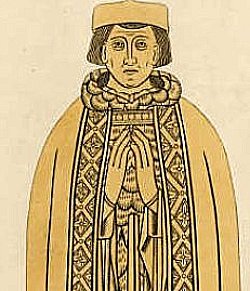
Christopher Urswick probably counted on modest posthumous fame. That memorial brass didn’t come cheap, and he wouldn’t have bargained for the elaborately decorated chantry chapel at Windsor being taken over for a princess’s tomb in future years. But pragmatists make bargains, and he had given up the exposed heights of political influence for the relative safety of semi retirement in the green fields of Hackney. So has had to settle for mentions in footnotes and bit part appearances in plays. And perhaps he would have settled for a road and a school in his adopted home town.

Like so many of the smartest operators in the Tudor world, the ones who were lucky enough, as well as wily enough, to live out their natural lifespan, Urswick appears to have stayed, for much of his career, out of the limelight.

Born in 1448 in Furness, both Urswick’s parents were lay members of the Abbey their ancestors had helped to found. Christopher probably went to school there before going on to Cambridge and ordination. As a young priest, he made the contact that was to change his life: an introduction to Margaret Beaufort, who offered him the position of chaplain in her household.

Margaret Beaufort had had a less than straightforward start in life. Heiress to the Duke of Somerset and descendant of Edward III, at the age of twelve she was married off. The choice of husband was that of the king, Henry VI, who was seeking a rich and aristocratic wife for his half brother, Edmund Tudor, son of his widowed mother’s scandalous remarriage to one of her own household. After her early death, Henry VI brought his half siblings to court and treated them with affection. But at the time of Margaret’s pathetically early marriage, one of the recurrent upheavals that future centuries were to call the Wars of the Roses broke out. The child bride’s husband, fighting for the Lancastrian cause, was imprisoned and then died of plague, and Margaret was left a pregnant widow at thirteen. Both Margaret and her baby survived the traumatic circumstances and difficult birth – but despite two more marriages she would bear no more children. Margaret Beaufort and her son Henry were to be close allies for all of both their lives, despite not meeting for long periods in the days before, against immense odds, he became king.

By the time Christopher Urswick took on his new role, Margaret Beaufort had married into the Stanley family, and her son Henry Tudor was in exile in Brittany. Edward IV had succeeded in keeping himself and his Yorkist faction in power for over a decade, had married Elizabeth Woodville and had, with her, become the father of a reassuringly large family of two surviving sons and five daughters. For as long as he lived, life in England was on a relatively even keel. But in 1483 the king died of a chill taken when he was out fishing, leaving a teenaged heir. Within weeks the faction fighting that had never been far under the surface was back. This time the two sides were fighting over who would control the young king. The events of the next months have become notorious: Edward IV’s younger brother, Richard of Gloucester, successfully argued that his brother’s marriage had not been lawful and his children illegitimate. The young Edward V and his brother soon vanished. Richard III is usually held to have had them murdered, but whether they really were killed and if so by whom has never been resolved.

As chaplain to the mother of the closest Lancastrian claimant to the throne and wife of a close ally of the new king, Urswick had a ringside seat for the tumultuous events of the next few years. Richard III was desperate to eliminate Henry Tudor, currently in exile in Brittany, by any means possible as well as to propitiate his own faction. Behind the scenes, Margaret Beaufort was in touch with the dowager queen Elizabeth Woodville, negotiating to arrange a marriage between their respective children, Henry Tudor and Elizabeth of York. Trusted chaplains were often employed as go-betweens, and it fell to Christopher Urswick to travel to Brittany as negotiator and to warn Henry of the danger he was in. From escaping from Brittany with five attendants, Henry was soon at the head of a mercenary army of French soldiers and planning to take the throne of England.

Christopher Urswick was present on the march through Wales and then England to meet the army of Richard III and present at the close-fought Battle of Bosworth, decided largely because Margaret Beaufort’s husband William Stanley, prudently waiting until the last minute to make sure he was backing the winning side, brought his 800 armed men in to fight for Henry on the day of the battle. Loyalty was a scarce commodity around kings and courts, and the new Henry VII appreciated it in Urswick, appointing him as almoner and loading him with an almost embarrassing number of appointments and rewards. He was, among other things, Dean at Windsor, where he created a chantry chapel which still exists, complete with the inscription asking for visitors to pray for the king, for Urswick and for anyone he might have offended.

Map of the Parish of Hackney, surveyed by John Rocque (c.1709-1762) 1745 (litho) by English School, (18th century); Private Collection;

Evidently Urswick tired of life at court. Among the multiplicity of deaneries, rectories and benefits of all kinds he acquired was the rectory of Hackney – on its own a decent living, valued at a goodly £35 a year in 1535. It was a sinecure rectory, which meant that the rector was not expected to do any of the work of the “cure of souls” – he appointed a vicar for that, at his own cost. But Urswick was to take an interest in local life, helping to restore the church (all that is now left is the church tower, as the rest of the mediaeval church was to be demolished after the new St John’s church was built in the 1790s). It is likely, too, that he helped to finance the building of the church house, on the site of what was to become the town hall, a building whose future is currently unclear. The vicar’s house was on a site north of the church, near where a Celtic cross now stands. And the rector’s own house was on the other site of Mare Street (then Church Street) – originally a mediaeval hall house, it is likely the Urswick improved it, adding chimneys and expensive brick external walls.

It is likely that Christopher Urswick had become disenchanted not only with life at court but with the new mood of anticlericalism that was blowing in from northern Europe. It is possible, too, that once Henry VIII became king in 1509 he did not care for those he brought with him. Too astute to fall out either with the king or with the higher echelons of the church, the Rector of Hackney gradually gave up most of his other appointments, busying himself mostly with local concerns and with correspondence. A friend of both Erasmus and Thomas More, Urswick lived out what appears to have been a peaceful old age. Evidently kindly as well as prosperous, he helped out the chronically impecunious Erasum with the (substantial) price of a new horse at least once. When Urswick finally died, probably in 1520, his will makes it clear he had kept up his interest in national affairs while concerning himself with his locality and servants – among many small bequests is 6s 8d to an “old poor man” who regularly walked over from Kentish Town to visit. Like other high status Tudors, Christopher Urswick habitually stamped his coat of arms over anything he influenced. But he added the three letters “MIA” for Misericordia – compassion. It seems to have been appropriate.

Permanent link to this article: http://lissachapman.co.uk/hackney/christopher-urswick/

A Common Name

Like so much else, it turned up when I was looking for something quite different.  An undistinguished looking medal in a red pouch, with Prince Albert looking portentous on one side and the word “exhibitor” on the other and “J Chapman, India” round the rim.  My great, great, great grandfather’s exhibitor’s medal from the 1851 Great Exhibition. 

A dispiriting number of my ancestors were called John Chapman, and for many years I had a great prejudice against them, and the Williams too.  It’s all the fault of my late, unlamented uncle, who spent much of his final years researching family history.  He was motivated, painstaking and lucky – the Johns, Williams and Thomases were mostly property owning yeomen in the same small area of the Midlands, starting with a thirteenth century William who had been MP for Derby.  My uncle had no interest in the women they married or fathered, and wrote a short history of the Chapmans, illustrated with a family tree which featured men only.  I was too young to complain, but took my revenge in ignoring the book and deciding the subjects must have been as dull as the author.

A partial mistake – in the nineteenth century there were two John Chapmans, second cousins, both ancestors of mine, who were far from boring.  Both were political radicals, both appear to have been people of extraordinary energy and motivation;  each has a DNB entry;  they knew one another, but could hardly have been more different in temperament. 

By this time the family had become Baptists:  a Georgian John Chapman had been converted and baptised in the River Quorn, thus making himself and his family into outsiders. So they sold up and moved to Loughborough, where one of them became a successful clock maker and political activist. 

The next John, with his brothers, started a bobbin making business.  They also became involved in radical politics at the time of the controversial campaign for the 1832 Reform Act.  John was a popular pro-Reform speaker – one especially impassioned meeting became a march and then a riot, with much of the audience setting off to burn down the local rectory:  the incumbent was a passionate opponent of reform.  It is not clear what happened next, but eye witnesses agreed that John Chapman placed himself outside the rectory, telling the would-be arsonists they would have to burn him as well.  Evidently the night ended peacefully.

At around this time the Chapman brothers’ business failed, and John was left with little but his books.    So he left his wife, Mary Wallis, a fellow Baptist and campaigner, and their children with her parents in Loughborough and walked to London to find work.  At first  he made mathematical instruments for a City firm, going on to make contacts and get work in journalistic and scientific circles.  Somewhere along the line he became interested in the possibilities of taking railway schemes to other countries and, by the mid 1840s, had become a passionate advocate of a railway for western India.  He came up with a suggested route and lobbied likely investors;  this was to become the Great India Peninsular Railway.. 

John Chapman was an unlikely railway promoter, and was certainly not a surveyor by trade.  But by whatever set of processes, in 1845 he found himself on a ship to India, tasked with meeting with local promoters and surveying the route.  Before the days of either steam ships or the Suez canal, this was a long and hazardous enterprise. Throughout the year-long trip he wrote regular letters to his beloved Mary; throughout the outward journey, trip across India by bullock cart, need for careful meetings and reports and equally time consuming and testing return journey, he kept his energy and resolve. 

Back in London, it was clear the scheme would go ahead.  But by now there were rich investors to negotiate with.  And tact and deference were beyond John Chapman.  He fell out, badly, with some of the more influential directors and was dismissed.  They kept his scheme – just did not want to pay him for it.  So the next years saw a ferocious battle for compensation;  John finally came away with a payment of £2,500 (worth perhaps a quarter of a million pounds in today’s terms).  And he went on to espouse other causes, often writing for “The Westminster Review”, owned by his second cousin, yet another John Chapman, an equally dynamic, but very different character.

It would be interesting to know more of the nature of John’s involvement in the Great Exhibition, which was after he had parted company with the GIPR.  Could he have been there as an individual?  If not, whose stand was he on?  It is easy to imagine him talking passionately to whoever passed by.  John Chapman packed a great deal into a relatively short life:  ironically, having survived all the dangers of his travels, he was to die very suddenly of cholera in 1854.  Well and cheerful in the morning, his wife found him dying at his desk in the afternoon, having had time to write half of one final book review. 

Permanent link to this article: http://lissachapman.co.uk/chapmans-and-others/a-common-name/

A very courteous subversion

Markhouse Road was notorious long before it was officially a road. When Walthamstow was a tangle of villages it had its share of grand houses. The Mark House, on the site of the parish boundary, stood until the 1890s. And the Low Hall, one of the mediaeval manor houses, in its final days presiding over the local sewage works, was close by. But by the early days of the nineteenth century the southern section of Markhouse Lane was lined with an assortment of the poorest sort of cottage, lived infor the most part by paupers, day labourers and street vendors.

Further to the east, Markhouse Common was an area of open land, providing, as it had for many centuries, a space for local people to graze their animals. But as the years went by, the railway got closer, London grew and fewer people kept cows or pigs, the area began to change.

The 1840s was the decade of Chartism. A few miles away, Hackney had become famous for its radical politics in the form of clubs, reading groups, meetings and publications. Walthamstow and Wanstead were smaller, quieter, and perhaps less organised, but there were open air meetings in Whipp’s Cross, Epping Forest and, reputedly, on Markhouse Common to take forward their demand for the vote for everyone – all men, anyway. There had been an early ambition to gain the vote for women too, but this was abandoned as an impossibility. At this time no reputable pub landlord would allow Chartists to meet on his premises for fear of the damage to his reputation.

And, for the moment, it all came to nothing. But in the aftermath of disappointment and recrimination, some of the Chartists’ ideas bore other kinds of fruit. One of those ideas was the Freehold Land Societies, forerunners of the building societies, but set up with wider aims. The plan was simple: a group of people would set up a society, with each member paying a fixed subscription so that, over a period of years, each participant would be able to build a house. And with the ownership of a freehold house came the right to vote. Very straightforward, totally non violent – and very subversive, as streets of new voters could, and did, change the political character of a town.

In Walthamstow, a section of land to the west end of Markhouse Road was sold to the National Freehold Land Society, laid out as Union and Prospect Roads and then developed. The houses were small, neat, flat fronted, each with its own garden. And very soon each became a home. The new residents were mostly skilled tradesmen: printers, lithographers, school masters, a surveyor – not of the status, or income, who would usually expect to own a home – renting was to be usual for most people for many more years. And each new freeholder became a voter. A mile or so away, off Hoe street, the Tower Hamlets Land Society bought and named a road after itself – bewildering passers by in every future generation.

All over England and in Walthamstow, too, other streets came into being in the same way, and the areas changed accordingly, both socially and politically, all perfectly within the rules and without waiting for the next Reform Act. Today few suspect the radical ancestry of the respectably mainstream building society. Around Markhouse Road, much has changed – the Mark House and the paupers’ cottages have all gone; Low Hall Farm was destroyed by a flying bomb in the Second World War, although some of the labourers’ cottages remain. The houses of Union and Prospect Roads appear to have been well built, but were flattened in the post war years to make way for a tower block, now demolished in its turn.

Permanent link to this article: http://lissachapman.co.uk/walthamstow/a-very-courteous-subversion/

Selborne Park

It’s less than two long lifetimes since Walthamstow was a string of semi rural villages, more prosperous than most.  Early in the nineteenth century Hoe Street was lined with grand houses, there was a stage coach commuter service, the railway was still half a century away, local government was organised by the parish, and residents had common land rights.  These included the right to graze your cows at most times of year as long as they were marked with your initials.

By the 1860s much had changed – the railway had got as far as Lea Bridge Road, the prosperous middle classes had begun to sell up and leave – and the common lands were being sold.  In some places this was a hugely controversial process:  in Walthamstow the changes were made with scarcely a blink.  The reality was that fewer local people had small holdings with cows to graze, and so had less use for the benefits the commons gave.  But the enclosures had effects that continue to this day.

But there were limits. The railway was a late arrival in Walthamstow, but when the time finally came to survey the most suitable route between the planned Hoe Street Station and Chingford, the choice fell upon part of the common land near St Mary’s Church, the Berry Field.  The Vestry – the parish committee that had organised most aspects of local government for many centuries – drove a hard bargain, negotiating not only a good purchase price but an undertaking to build the railway in a cutting which was to be planted with trees, and any excess land to be made available as a recreation area – as it still is.

After much consideration, the committee decided to buy the land that is now Selborne Park, carefully minuting that it was to belong to the people of Walthamstow.  Once the new Council came into being in the early 1870s, the Vestry agreed that a Council Officer should “interest himself” in the management of the park.  But that was all.  As time went on the Council seem to have assumed that the land was theirs.

All through the nineteenth and twentieth centuries, the park was the venue for many concerts, meetings and performances.  There were roundabouts, a slide, a giant chess board, boules, a café and carefully tended planting.  During the First World War one of the newly invented tanks came to visit as part of a fundraiser to persuade local people to contribute to the price of more tanks and guns. Bands played, minor scuffles were quelled and endless impromptu football games played.  In later years there was a public art project

It was not until the late 1970s, after the Victoria Line came to town, that the local authority took a chunk of the park space for a new bus garage.  Then another chunk vanished to provide a shopping mall – the land was sold to the developers on a long lease.  Only around a third of the original park remains, and much of that, and many trees, are threatened by a planned development that offers increased retail space no one wants, luxury flats no one can afford, further pressure on already overstretched transport and services and one small play space for children.  A poor bargain.

Permanent link to this article: http://lissachapman.co.uk/walthamstow/selborne-park/